
当前位置:
X-MOL 学术
›
J. Appl. Polym. Sci.
›
论文详情
Our official English website, www.x-mol.net, welcomes your
feedback! (Note: you will need to create a separate account there.)
Nano/microfibers of EVA copolymer obtained by solution blow spinning: Processing, solution properties, and pheromone release application
Journal of Applied Polymer Science ( IF 2.8 ) Pub Date : 2019-02-15 , DOI: 10.1002/app.47647 Silvana Pereira Rempel , Leonardo Galli Engler , Márcio R. F. Soares , Jadna Catafesta , Sidnei Moura , Otávio Bianchi
Journal of Applied Polymer Science ( IF 2.8 ) Pub Date : 2019-02-15 , DOI: 10.1002/app.47647 Silvana Pereira Rempel , Leonardo Galli Engler , Márcio R. F. Soares , Jadna Catafesta , Sidnei Moura , Otávio Bianchi
|
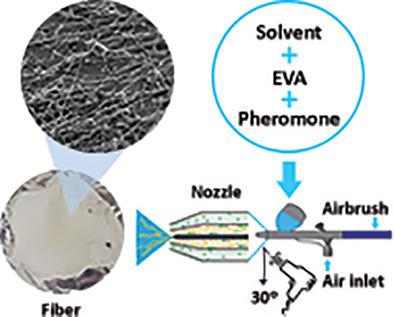
Pheromones have been used for monitoring and control of insect pests in crops, reducing the use of pesticides. However, among obstacles for this technology to be more useful, is the control and time to release. In this way, this work aims the evaluation of the release of pheromones using micro/nanofibers of ethylene–vinyl acetate (EVA) produced by blow spinning. Solutions with 0.5–15 wt % EVA were prepared based on the solubility parameter of the copolymer. Fibers were obtained from solutions in the semidiluted concentration regime. Synthetic sex pheromones from the oriental fruit moth, Grapholita molesta and citrus leafminer Phyllocnistis citrella were incorporated into the micro/nanofibers. The morphology and structure of these fibers were evaluated employing field emission scanning electron microscopy and wide‐angle X‐ray diffraction. The fibers sizes (95–426 nm) were dependent on the feed rate of the solution. As a result, pheromone release has occurred linearly over 10 weeks, as determined by thermogravimetry analysis. The solubility parameter influences the amount incorporated in the fiber and the rate of pheromone release. The proposed fiber/pheromone system is interesting since it reduces the use of actives and can be used in several planting cycles and reused. © 2019 Wiley Periodicals, Inc. J. Appl. Polym. Sci. 2019, 136, 47647.
中文翻译:

通过溶液吹纺获得的EVA共聚物的纳米/超细纤维:加工,溶液性质和信息素释放应用
信息素已用于监测和控制农作物中的害虫,减少了农药的使用。但是,要使该技术更有用的障碍之一是控制和释放时间。通过这种方式,这项工作旨在利用通过吹纺生产的乙烯-醋酸乙烯酯(EVA)的微纤维/纳米纤维来评估信息素的释放。根据共聚物的溶解度参数,制备具有0.5–15 wt%EVA的溶液。从溶液中以半稀释浓度获得纤维。东方飞蛾,Grapholita molesta和柑桔除叶蝇Phyllocnistis citrella的合成性信息素被并入微纤维/纳米纤维。使用场发射扫描电子显微镜和广角X射线衍射对这些纤维的形态和结构进行了评估。纤维尺寸(95-426 nm)取决于溶液的进料速度。结果,如通过热重分析所确定的,信息素释放在10周内线性发生。溶解度参数影响掺入纤维的量和信息素的释放速率。所提出的纤维/信息素系统很有趣,因为它减少了活性物质的使用,并且可以在多个种植周期中使用并可以重复使用。分级为4 +©2019 Wiley Periodicals,Inc.J.Appl。Polym。科学 2019,136,47647。
更新日期:2019-02-15
中文翻译:
通过溶液吹纺获得的EVA共聚物的纳米/超细纤维:加工,溶液性质和信息素释放应用
信息素已用于监测和控制农作物中的害虫,减少了农药的使用。但是,要使该技术更有用的障碍之一是控制和释放时间。通过这种方式,这项工作旨在利用通过吹纺生产的乙烯-醋酸乙烯酯(EVA)的微纤维/纳米纤维来评估信息素的释放。根据共聚物的溶解度参数,制备具有0.5–15 wt%EVA的溶液。从溶液中以半稀释浓度获得纤维。东方飞蛾,Grapholita molesta和柑桔除叶蝇Phyllocnistis citrella的合成性信息素被并入微纤维/纳米纤维。使用场发射扫描电子显微镜和广角X射线衍射对这些纤维的形态和结构进行了评估。纤维尺寸(95-426 nm)取决于溶液的进料速度。结果,如通过热重分析所确定的,信息素释放在10周内线性发生。溶解度参数影响掺入纤维的量和信息素的释放速率。所提出的纤维/信息素系统很有趣,因为它减少了活性物质的使用,并且可以在多个种植周期中使用并可以重复使用。分级为4 +©2019 Wiley Periodicals,Inc.J.Appl。Polym。科学 2019,136,47647。


















































 京公网安备 11010802027423号