
当前位置:
X-MOL 学术
›
Anal. Chem.
›
论文详情
Our official English website, www.x-mol.net, welcomes your
feedback! (Note: you will need to create a separate account there.)
Machine-Learning-Based Olfactometer: Prediction of Odor Perception from Physicochemical Features of Odorant Molecules
Analytical Chemistry ( IF 6.7 ) Pub Date : 2017-11-07 00:00:00 , DOI: 10.1021/acs.analchem.7b02389 Liang Shang , Chuanjun Liu , Yoichi Tomiura , Kenshi Hayashi
Analytical Chemistry ( IF 6.7 ) Pub Date : 2017-11-07 00:00:00 , DOI: 10.1021/acs.analchem.7b02389 Liang Shang , Chuanjun Liu , Yoichi Tomiura , Kenshi Hayashi
|
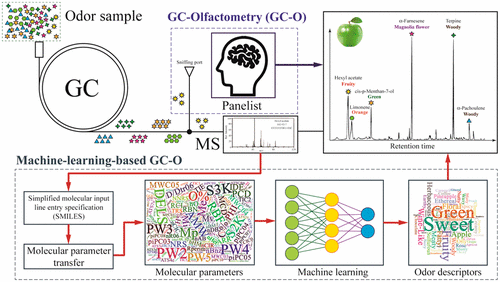
Gas chromatography/olfactometry (GC/O) has been used in various fields as a valuable method to identify odor-active components from a complex mixture. Since human assessors are employed as detectors to obtain the olfactory perception of separated odorants, the GC/O technique is limited by its subjectivity, variability, and high cost of the trained panelists. Here, we present a proof-of-concept model by which odor information can be obtained by machine-learning-based prediction from molecular parameters (MPs) of odorant molecules. The odor prediction models were established using a database of flavors and fragrances including 1026 odorants and corresponding verbal odor descriptors (ODs). Physicochemical parameters of the odorant molecules were acquired by use of molecular calculation software (DRAGON). Ten representative ODs were selected to build the prediction models based on their high frequency of occurrence in the database. The features of the MPs were extracted via either unsupervised (principal component analysis) or supervised (Boruta, BR) approaches and then used as input to calibrate machine-learning models. Predictions were performed by various machine-learning approaches such as support vector machine (SVM), random forest, and extreme learning machine. All models were optimized via parameter tuning and their prediction accuracies were compared. A SVM model combined with feature extraction by BR-C (confirmed only) was found to afford the best results with an accuracy of 97.08%. Validation of the models was verified by using the GC/O data of an apple sample for comparison between the predicted and measured results. The prediction models can be used as an auxiliary tool in the existing GC/O by suggesting possible OD candidates to the panelists and thus helping to give more objective and correct judgment. In addition, a machine-based GC/O in which the panelist is no longer needed might be expected after further development of the proposed odor prediction technique.
中文翻译:

基于机器学习的嗅觉仪:根据气味分子的理化特征预测气味感知
气相色谱/比色法(GC / O)已在各种领域中用作从复杂混合物中识别气味活性成分的有价值的方法。由于使用了人类评估员作为检测器来获得分离的增香剂的嗅觉,因此GC / O技术受到其主观性,可变性和训练有素的小组成员的高昂费用的限制。在这里,我们提出了一个概念验证模型,通过该模型,可以根据气味分子的分子参数(MP)通过基于机器学习的预测获得气味信息。气味预测模型是使用包含1026种气味剂和相应口头气味描述符(OD)的香精和香料数据库建立的。气味分子的理化参数通过分子计算软件(DRAGON)获得。根据数据库中出现的频繁程度,选择了十个代表性OD来构建预测模型。MP的特征是通过无监督(主要成分分析)或有监督(Boruta,BR)方法提取的,然后用作校准机器学习模型的输入。通过各种机器学习方法(例如支持向量机(SVM),随机森林和极限学习机)来进行预测。通过参数调整对所有模型进行了优化,并对它们的预测准确性进行了比较。发现SVM模型与通过BR-C进行的特征提取相结合(仅已确认)可提供最佳结果,准确度为97.08%。通过使用苹果样品的GC / O数据验证模型的有效性,以比较预测结果和测量结果。通过向小组成员建议可能的OD候选者,预测模型可以用作现有GC / O中的辅助工具,从而有助于给出更客观和正确的判断。另外,在进一步发展所提出的气味预测技术之后,可能会期望不再需要专门小组成员的基于机器的GC / O。
更新日期:2017-11-08
中文翻译:
基于机器学习的嗅觉仪:根据气味分子的理化特征预测气味感知
气相色谱/比色法(GC / O)已在各种领域中用作从复杂混合物中识别气味活性成分的有价值的方法。由于使用了人类评估员作为检测器来获得分离的增香剂的嗅觉,因此GC / O技术受到其主观性,可变性和训练有素的小组成员的高昂费用的限制。在这里,我们提出了一个概念验证模型,通过该模型,可以根据气味分子的分子参数(MP)通过基于机器学习的预测获得气味信息。气味预测模型是使用包含1026种气味剂和相应口头气味描述符(OD)的香精和香料数据库建立的。气味分子的理化参数通过分子计算软件(DRAGON)获得。根据数据库中出现的频繁程度,选择了十个代表性OD来构建预测模型。MP的特征是通过无监督(主要成分分析)或有监督(Boruta,BR)方法提取的,然后用作校准机器学习模型的输入。通过各种机器学习方法(例如支持向量机(SVM),随机森林和极限学习机)来进行预测。通过参数调整对所有模型进行了优化,并对它们的预测准确性进行了比较。发现SVM模型与通过BR-C进行的特征提取相结合(仅已确认)可提供最佳结果,准确度为97.08%。通过使用苹果样品的GC / O数据验证模型的有效性,以比较预测结果和测量结果。通过向小组成员建议可能的OD候选者,预测模型可以用作现有GC / O中的辅助工具,从而有助于给出更客观和正确的判断。另外,在进一步发展所提出的气味预测技术之后,可能会期望不再需要专门小组成员的基于机器的GC / O。



















































 京公网安备 11010802027423号