
Nature Communications ( IF 15.7 ) Pub Date : 2025-06-04 , DOI: 10.1038/s41467-025-60296-1 Alejandro Tlaie , Muad Y. Abd El Hay , Berkutay Mert , Robert Taylor , Pierre-Antoine Ferracci , Katharine Shapcott , Mina Glukhova , Jonathan W. Pillow , Martha N. Havenith , Marieke L. Schölvinck
|
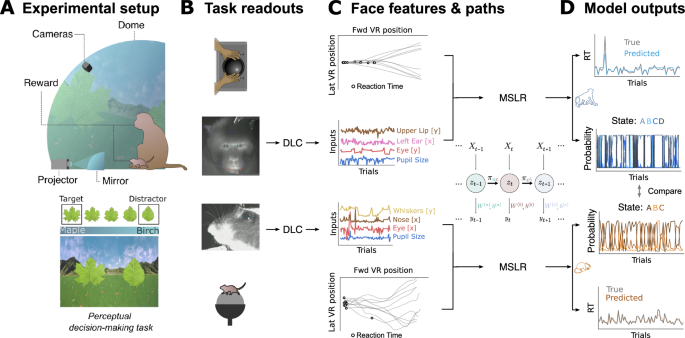
Animal behaviour is shaped to a large degree by internal cognitive states, but it is unknown whether these states are similar across species. To address this question, here we develop a virtual reality setup in which male mice and macaques engage in the same naturalistic visual foraging task. We exploit the richness of a wide range of facial features extracted from video recordings during the task, to train a Markov-Switching Linear Regression (MSLR). By doing so, we identify, on a single-trial basis, a set of internal states that reliably predicts when the animals are going to react to the presented stimuli. Even though the model is trained purely on reaction times, it can also predict task outcome, supporting the behavioural relevance of the inferred states. The relationship of the identified states to task performance is comparable between mice and monkeys. Furthermore, each state corresponds to a characteristic pattern of facial features that partially overlaps between species, highlighting the importance of facial expressions as manifestations of internal cognitive states across species.
中文翻译:

使用面部特征推断小鼠和猴子的内部状态
动物的行为在很大程度上受到内部认知状态的影响,但尚不清楚这些状态在不同物种之间是否相似。为了解决这个问题,我们在这里开发了一个虚拟现实设置,其中雄性老鼠和猕猴从事相同的自然主义视觉觅食任务。我们利用任务期间从视频记录中提取的各种面部特征的丰富性,来训练马尔可夫切换线性回归 (MSLR)。通过这样做,我们在单次试验的基础上确定了一组内部状态,这些状态可靠地预测动物何时会对呈现的刺激做出反应。尽管该模型纯粹根据反应时间进行训练,但它也可以预测任务结果,从而支持推断状态的行为相关性。已识别的状态与任务表现的关系在小鼠和猴子之间具有可比性。此外,每种状态对应于物种之间部分重叠的面部特征模式,突出了面部表情作为跨物种内部认知状态表现的重要性。






















































 京公网安备 11010802027423号