
当前位置:
X-MOL 学术
›
Pest Manag. Sci.
›
论文详情
Our official English website, www.x-mol.net, welcomes your
feedback! (Note: you will need to create a separate account there.)
Auxin‐mimic herbicides dilema: Their benefits and limitations
Pest Management Science ( IF 3.8 ) Pub Date : 2025-05-22 , DOI: 10.1002/ps.8913 Natália S Garcia , Franck E Dayan , Edinalvo R Camargo , Bruna C Ceolin , Sidnei Deuner , Luis A de Avila
Pest Management Science ( IF 3.8 ) Pub Date : 2025-05-22 , DOI: 10.1002/ps.8913 Natália S Garcia , Franck E Dayan , Edinalvo R Camargo , Bruna C Ceolin , Sidnei Deuner , Luis A de Avila
|
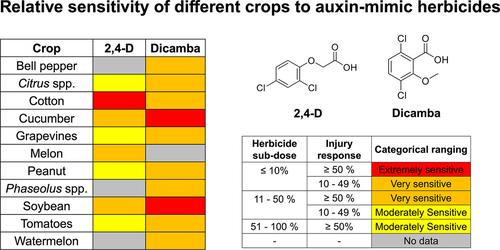
BACKGROUNDAuxinic herbicides have revolutionized weed control since their introduction in agriculture in 1945. In recent years, auxinic herbicides have become essential and cost‐effective weed management tools to control glyphosate‐resistant and other difficult‐to‐control weeds in soybean and cotton. The recent commercialization of auxinic‐resistant crops (ARC) (i.e., soybean and cotton) allows preemergent and in‐season post‐emergent applications of auxinic herbicides. However, the off‐target movement of auxinic herbicides has been a recurring problem, threatening the livelihood of growers producing sensitive plants such as cucurbits, tomatoes, and grapevines. It is challenging to pinpoint the exact source of the drift and assess the short and long‐term impacts of auxinic herbicides drift to sensitive surrounding vegetation. In this context, we provide an overview on the relative sensitivity of several important crops to very low doses of the auxinic herbicides dicamba and 2,4‐D.RESULTSGiven the wide range of effects triggered by auxinic herbicides in plant metabolism, sensitive crops are highly variable in their responses to sublethal doses; however, there is a consensus that crop symptomatology is not always predictive of yield loss or growth penalties. These studies demonstrate the difficulty of observing patterns that indicate when management decisions should be made after a suspected off‐target movement event.CONCLUSIONSeveral crops are sensitive to auxinic herbicides, which can cause damage and may affect crop yield. Therefore, there is a need to develop a low‐cost and consistent diagnosis tool to detect very low doses of auxinic herbicides in sensitive species in the field, thus the losses of produced crop due to contamination with the auxinic herbicides in concentrations above the limit for consumption could be rapidly detected. This review demonstrates that ARC is sustainable in weed management only if application practices are improved to minimize unintended off‐target damage. © 2025 Society of Chemical Industry.
中文翻译:

生长素模拟除草剂的困境:它们的好处和局限性
背景自 1945 年引入农业以来,优素除草剂彻底改变了杂草控制。近年来,辅助除草剂已成为控制大豆和棉花中抗草甘膦和其他难控制杂草的重要且具有成本效益的杂草管理工具。最近抗助剂作物 (ARC)(即大豆和棉花)的商业化允许在出苗前和出苗后季节内施用助剂除草剂。然而,助草剂的脱靶移动一直是一个反复出现的问题,威胁着生产葫芦科植物、西红柿和葡萄藤等敏感植物的种植者的生计。查明漂移的确切来源并评估辅助除草剂漂移对周围敏感植被的短期和长期影响具有挑战性。在此背景下,我们概述了几种重要作物对极低剂量的助性除草剂麦草畏和 2,4-D 的相对敏感性。结果鉴于助性除草剂在植物代谢中引发的广泛影响,敏感作物对亚致死剂量的反应变化很大;然而,人们一致认为,作物症状并不总是能预测产量损失或生长损失。这些研究表明,观察指示在疑似脱靶运动事件后何时应做出管理决策的模式是困难的。结论多种作物对助性除草剂敏感,可造成损害,影响作物产量。 因此,需要开发一种低成本且一致的诊断工具来检测田间敏感物种中极低剂量的助性除草剂,从而可以快速检测因浓度超过消费限值的助性除草剂污染而导致的作物损失。本综述表明,只有改进施用实践以尽量减少意外脱靶损害,ARC 才能在杂草管理中可持续。© 2025 年化学工业学会.
更新日期:2025-05-22
中文翻译:
生长素模拟除草剂的困境:它们的好处和局限性
背景自 1945 年引入农业以来,优素除草剂彻底改变了杂草控制。近年来,辅助除草剂已成为控制大豆和棉花中抗草甘膦和其他难控制杂草的重要且具有成本效益的杂草管理工具。最近抗助剂作物 (ARC)(即大豆和棉花)的商业化允许在出苗前和出苗后季节内施用助剂除草剂。然而,助草剂的脱靶移动一直是一个反复出现的问题,威胁着生产葫芦科植物、西红柿和葡萄藤等敏感植物的种植者的生计。查明漂移的确切来源并评估辅助除草剂漂移对周围敏感植被的短期和长期影响具有挑战性。在此背景下,我们概述了几种重要作物对极低剂量的助性除草剂麦草畏和 2,4-D 的相对敏感性。结果鉴于助性除草剂在植物代谢中引发的广泛影响,敏感作物对亚致死剂量的反应变化很大;然而,人们一致认为,作物症状并不总是能预测产量损失或生长损失。这些研究表明,观察指示在疑似脱靶运动事件后何时应做出管理决策的模式是困难的。结论多种作物对助性除草剂敏感,可造成损害,影响作物产量。 因此,需要开发一种低成本且一致的诊断工具来检测田间敏感物种中极低剂量的助性除草剂,从而可以快速检测因浓度超过消费限值的助性除草剂污染而导致的作物损失。本综述表明,只有改进施用实践以尽量减少意外脱靶损害,ARC 才能在杂草管理中可持续。© 2025 年化学工业学会.






















































 京公网安备 11010802027423号