
当前位置:
X-MOL 学术
›
Chem. Rev.
›
论文详情
Our official English website, www.x-mol.net, welcomes your
feedback! (Note: you will need to create a separate account there.)
Perovskite Solar Cells and Light Emitting Diodes: Materials Chemistry, Device Physics and Relationship
Chemical Reviews ( IF 55.8 ) Pub Date : 2025-05-21 , DOI: 10.1021/acs.chemrev.4c00663 Ligang Yuan , Qifan Xue , Feng Wang , Ning Li , Geoffrey I. N. Waterhouse , Christoph J. Brabec , Feng Gao , Keyou Yan
Chemical Reviews ( IF 55.8 ) Pub Date : 2025-05-21 , DOI: 10.1021/acs.chemrev.4c00663 Ligang Yuan , Qifan Xue , Feng Wang , Ning Li , Geoffrey I. N. Waterhouse , Christoph J. Brabec , Feng Gao , Keyou Yan
|
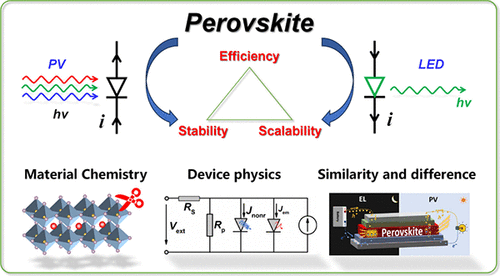
Solution-processed perovskite solar cells (PSCs) and perovskite light emitting diodes (PeLEDs) represent promising next-generation optoelectronic technologies. This Review summarizes recent advancements in the application of metal halide perovskite materials for PSC and PeLED devices to address the efficiency, stability and scalability issues. Emphasis is placed on material chemistry strategies used to control and engineer the composition, deposition process, interface and micro-nanostructure in solution-processed perovskite films, leading to high-quality crystalline thin films for optimal device performance. Furthermore, we retrospectively compare the device physics of PSCs and PeLEDs, their working principles and their energy loss mechanisms, examining the similarities and differences between the two types of devices. The reciprocity relationship suggests that a great PSC should also be a great PeLED, motivating the search for interconverting photoelectric bifunctional devices with maximum radiative recombination and negligible non-radiative recombination. Specific requirements of PSCs and PeLEDs in terms of bandgap, thickness, band alignment and charge transport to achieve this target are discussed in detail. Further challenges and issues are also illustrated, together with prospects for future development. Understanding these fundamentals, embracing recent breakthroughs and exploring future prospects pave the way toward the rational design and development of high-performance PSC and PeLED devices.
中文翻译:

钙钛矿太阳能电池和发光二极管:材料化学、器件物理学和关系
溶液处理的钙钛矿太阳能电池 (PSC) 和钙钛矿发光二极管 (PeLED) 代表了前景广阔的下一代光电技术。本文总结了金属卤化物钙钛矿材料在 PSC 和 PeLED 器件中的应用的最新进展,以解决效率、稳定性和可扩展性问题。重点放在用于控制和设计溶液处理钙钛矿薄膜中的成分、沉积过程、界面和微纳米结构的材料化学策略上,从而产生高质量的晶体薄膜以实现最佳器件性能。此外,我们回顾性地比较了 PSC 和 PeLED 的器件物理学、它们的工作原理和能量损失机制,研究了两种器件之间的异同。互惠关系表明,出色的 PSC 也应该是出色的 PeLED,这促使人们寻找具有最大辐射复合和可忽略不计的非辐射复合的互转换光电双功能器件。详细讨论了 PSC 和 PeLED 在带隙、厚度、能带对齐和电荷传输方面的具体要求,以实现这一目标。此外,还说明了其他挑战和问题,以及未来发展的前景。了解这些基本原理,接受最近的突破并探索未来前景,为高性能 PSC 和 PeLED 器件的合理设计和开发铺平了道路。
更新日期:2025-05-21
中文翻译:
钙钛矿太阳能电池和发光二极管:材料化学、器件物理学和关系
溶液处理的钙钛矿太阳能电池 (PSC) 和钙钛矿发光二极管 (PeLED) 代表了前景广阔的下一代光电技术。本文总结了金属卤化物钙钛矿材料在 PSC 和 PeLED 器件中的应用的最新进展,以解决效率、稳定性和可扩展性问题。重点放在用于控制和设计溶液处理钙钛矿薄膜中的成分、沉积过程、界面和微纳米结构的材料化学策略上,从而产生高质量的晶体薄膜以实现最佳器件性能。此外,我们回顾性地比较了 PSC 和 PeLED 的器件物理学、它们的工作原理和能量损失机制,研究了两种器件之间的异同。互惠关系表明,出色的 PSC 也应该是出色的 PeLED,这促使人们寻找具有最大辐射复合和可忽略不计的非辐射复合的互转换光电双功能器件。详细讨论了 PSC 和 PeLED 在带隙、厚度、能带对齐和电荷传输方面的具体要求,以实现这一目标。此外,还说明了其他挑战和问题,以及未来发展的前景。了解这些基本原理,接受最近的突破并探索未来前景,为高性能 PSC 和 PeLED 器件的合理设计和开发铺平了道路。





























 京公网安备 11010802027423号