
Our official English website, www.x-mol.net, welcomes your
feedback! (Note: you will need to create a separate account there.)
Stress-induced pro-inflammatory glioblastoma stem cells secrete TNFAIP6 to enhance tumor growth and induce suppressive macrophages
Developmental Cell ( IF 8.7 ) Pub Date : 2025-05-21 , DOI: 10.1016/j.devcel.2025.04.027 Danling Gu , Lang Hu , Kailin Yang , Wei Yuan , Danyang Shan , Jiancheng Gao , Jiahuang Li , Ryan C. Gimple , Deobrat Dixit , Zhe Zhu , Daqi Li , Qiulian Wu , Zhumei Shi , Yingyi Wang , Ningwei Zhao , Kun Yang , Junfei Shao , Fan Lin , Qianghu Wang , Guangfu Jin , Yun Chen , Xu Qian , Zhibin Hu , Chaojun Li , Nu Zhang , Yongping You , Jian Liu , Qian Zhang , Junxia Zhang , Jeremy N. Rich , Xiuxing Wang
Developmental Cell ( IF 8.7 ) Pub Date : 2025-05-21 , DOI: 10.1016/j.devcel.2025.04.027 Danling Gu , Lang Hu , Kailin Yang , Wei Yuan , Danyang Shan , Jiancheng Gao , Jiahuang Li , Ryan C. Gimple , Deobrat Dixit , Zhe Zhu , Daqi Li , Qiulian Wu , Zhumei Shi , Yingyi Wang , Ningwei Zhao , Kun Yang , Junfei Shao , Fan Lin , Qianghu Wang , Guangfu Jin , Yun Chen , Xu Qian , Zhibin Hu , Chaojun Li , Nu Zhang , Yongping You , Jian Liu , Qian Zhang , Junxia Zhang , Jeremy N. Rich , Xiuxing Wang
|
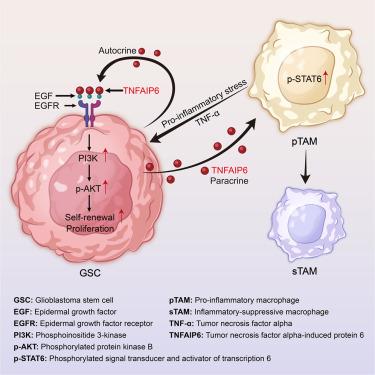
Glioblastoma (GBM) is the most aggressive primary intracranial tumor, with glioblastoma stem cells (GSCs) enforcing the intratumoral hierarchy. The inflammatory microenvironment influences tumor development at varying stages, while the underlying mechanism of GSCs facing pro-inflammatory stress remains unclear. Here, we show that, in human GBM, pro-inflammatory stress from pro-inflammatory macrophages (pTAMs) maintains GSC proliferation and self-renewal. Tumor necrosis factor alpha-induced protein 6 (TNFAIP6), as a responder in patient-derived GSCs to pro-inflammatory stress tumor necrosis factor alpha (TNF-α) from human pTAMs, promotes tumor growth through binding epidermal growth factor (EGF) and prolonging EGF receptor (EGFR)-phosphatidylinositol 3-kinase (PI3K)-protein kinase B (AKT) signaling activation. Meanwhile, pro-inflammatory stress-induced patient-derived GSCs secrete TNFAIP6 to transform macrophage phenotype from pTAMs to inflammatory-suppressive macrophages (sTAMs). Collectively, pharmacological or genetic disruption of TNFAIP6 autocrine and paracrine communication between patient-derived GSCs and TAMs inhibited GSC proliferation and self-renewal in vitro and in patient-derived xenograft tumor-bearing mice, suggesting that TNFAIP6 is an effective target for GBM therapy.
中文翻译:

应激诱导的促炎胶质母细胞瘤干细胞分泌 TNFAIP6 以促进肿瘤生长并诱导抑制性巨噬细胞
胶质母细胞瘤 (GBM) 是最具侵袭性的原发性颅内肿瘤,胶质母细胞瘤干细胞 (GSC) 强制瘤内层次结构。炎症微环境影响不同阶段的肿瘤发展,而 GSCs 面临促炎应激的潜在机制仍不清楚。在这里,我们表明,在人类 GBM 中,来自促炎巨噬细胞 (pTAM) 的促炎应激维持了 GSC 增殖和自我更新。肿瘤坏死因子α诱导蛋白 6(TNFAIP6)作为患者来源的 GSC 对来自人类 pTAM 的促炎应激肿瘤坏死因子α(TNF-α)的反应者,通过结合表皮生长因子(EGF)和延长 EGF 受体(EGFR)-磷脂酰肌醇 3-激酶(PI3K)-蛋白激酶 B(AKT)信号激活来促进肿瘤生长。同时,促炎应激诱导的患者来源的 GSC 分泌 TNFAIP6,将巨噬细胞表型从 pTAM 转化为炎症抑制巨噬细胞 (sTAM)。总的来说,患者来源的 GSC 和 TAM 之间 TNFAIP6 自分泌和旁分泌通讯的药理学或遗传破坏抑制了 GSC 在体外和患者来源的异种移植荷瘤小鼠中的增殖和自我更新,表明 TNFAIP6 是 GBM 治疗的有效靶点。
更新日期:2025-05-21
中文翻译:
应激诱导的促炎胶质母细胞瘤干细胞分泌 TNFAIP6 以促进肿瘤生长并诱导抑制性巨噬细胞
胶质母细胞瘤 (GBM) 是最具侵袭性的原发性颅内肿瘤,胶质母细胞瘤干细胞 (GSC) 强制瘤内层次结构。炎症微环境影响不同阶段的肿瘤发展,而 GSCs 面临促炎应激的潜在机制仍不清楚。在这里,我们表明,在人类 GBM 中,来自促炎巨噬细胞 (pTAM) 的促炎应激维持了 GSC 增殖和自我更新。肿瘤坏死因子α诱导蛋白 6(TNFAIP6)作为患者来源的 GSC 对来自人类 pTAM 的促炎应激肿瘤坏死因子α(TNF-α)的反应者,通过结合表皮生长因子(EGF)和延长 EGF 受体(EGFR)-磷脂酰肌醇 3-激酶(PI3K)-蛋白激酶 B(AKT)信号激活来促进肿瘤生长。同时,促炎应激诱导的患者来源的 GSC 分泌 TNFAIP6,将巨噬细胞表型从 pTAM 转化为炎症抑制巨噬细胞 (sTAM)。总的来说,患者来源的 GSC 和 TAM 之间 TNFAIP6 自分泌和旁分泌通讯的药理学或遗传破坏抑制了 GSC 在体外和患者来源的异种移植荷瘤小鼠中的增殖和自我更新,表明 TNFAIP6 是 GBM 治疗的有效靶点。






































 京公网安备 11010802027423号