
Nature Astronomy ( IF 14.3 ) Pub Date : 2024-04-12 , DOI: 10.1038/s41550-024-02237-4 Peter K. Blanchard , V. Ashley Villar , Ryan Chornock , Tanmoy Laskar , Yijia Li , Joel Leja , Justin Pierel , Edo Berger , Raffaella Margutti , Kate D. Alexander , Jennifer Barnes , Yvette Cendes , Tarraneh Eftekhari , Daniel Kasen , Natalie LeBaron , Brian D. Metzger , James Muzerolle Page , Armin Rest , Huei Sears , Daniel M. Siegel , S. Karthik Yadavalli
|
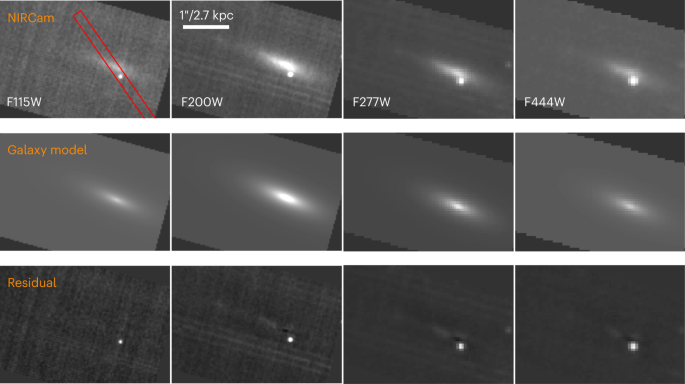
Identifying the sites of r-process nucleosynthesis, a primary mechanism of heavy element production, is a key goal of astrophysics. The discovery of the brightest gamma-ray burst (GRB) to date, GRB 221009A, presented an opportunity to spectroscopically test the idea that r-process elements are produced following the collapse of rapidly rotating massive stars. Here we present James Webb Space Telescope observations of GRB 221009A obtained +168 and +170 rest-frame days after the gamma-ray trigger, and demonstrate that they are well described by a SN 1998bw-like supernova (SN) and power-law afterglow, with no evidence for a component from r-process emission. The SN, with a nickel mass of approximately 0.09 M⊙, is only slightly fainter than the brightness of SN 1998bw at this phase, which indicates that the SN is not an unusual GRB-SN. This demonstrates that the GRB and SN mechanisms are decoupled and that highly energetic GRBs are not likely to produce significant quantities of r-process material, which leaves open the question of whether explosions of massive stars are key sources of r-process elements. Moreover, the host galaxy of GRB 221009A has a very low metallicity of approximately 0.12 Z⊙ and strong H2 emission at the explosion site, which is consistent with recent star formation, hinting that environmental factors are responsible for its extreme energetics.
中文翻译:

JWST 检测到与 GRB 221009A 相关的超新星,没有 r 过程签名
确定 r 过程核合成(重元素产生的主要机制)的位点是天体物理学的一个关键目标。迄今为止最亮的伽马射线暴 (GRB) GRB 221009A 的发现提供了一个机会,可以通过光谱检验 r 过程元素是在快速旋转的大质量恒星崩溃后产生的这一想法。在这里,我们展示了詹姆斯·韦伯太空望远镜对 GRB 221009A 的观测,在伽马射线触发后获得了 +168 和 +170 个休息帧天,并证明它们可以通过类似 SN 1998bw 的超新星 (SN) 和幂律余辉来很好地描述,没有证据表明来自 r 过程排放的成分。 SN的镍质量约为0.09 M ⊙ ,在此阶段的亮度仅比SN 1998bw稍暗,这表明SN不是一个不寻常的GRB-SN。这表明GRB和SN机制是解耦的,高能GRB不太可能产生大量的r过程材料,这就留下了大质量恒星的爆炸是否是r过程元素的关键来源的问题。此外,GRB 221009A的宿主星系具有非常低的金属丰度,约为0.12 Z ⊙ ,并且在爆炸地点有强烈的H 2发射,这与最近的恒星形成一致,暗示环境因素是其极端能量的原因。











































 京公网安备 11010802027423号