
Scientific Reports ( IF 3.9 ) Pub Date : 2024-04-12 , DOI: 10.1038/s41598-024-59099-z Peter Lukacs , Theodosia Stratoudaki , Geo Davis , Anthony Gachagan
|
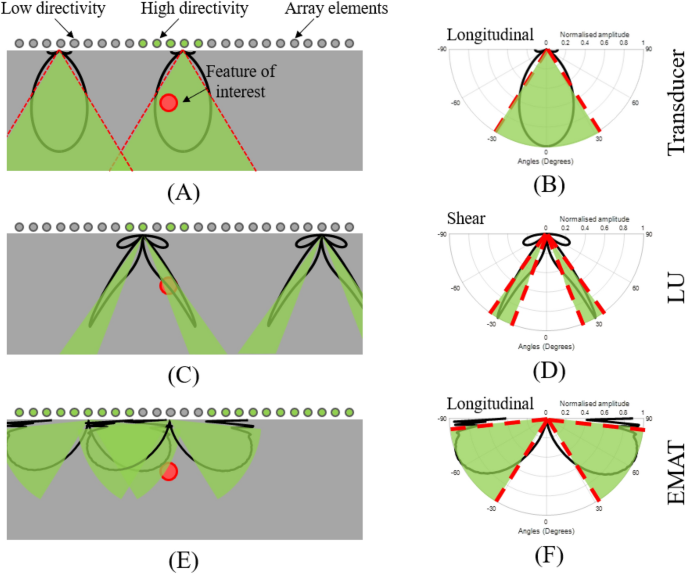
Ultrasonic imaging, using ultrasonic phased arrays, has an enormous impact in science, medicine and society and is a widely used modality in many application fields. The maximum amount of information which can be captured by an array is provided by the data acquisition method capturing the complete data set of signals from all possible combinations of ultrasonic generation and detection elements of a dense array. However, capturing this complete data set requires long data acquisition time, large number of array elements and transmit channels and produces a large volume of data. All these reasons make such data acquisition unfeasible due to the existing phased array technology or non-applicable to cases requiring fast measurement time. This paper introduces the concept of an adaptive data acquisition process, the Selective Matrix Capture (SMC), which can adapt, dynamically, to specific imaging requirements for efficient ultrasonic imaging. SMC is realised experimentally using Laser Induced Phased Arrays (LIPAs), that use lasers to generate and detect ultrasound. The flexibility and reconfigurability of LIPAs enable the evolution of the array configuration, on-the-fly. The SMC methodology consists of two stages: a stage for detecting and localising regions of interest, by means of iteratively synthesising a sparse array, and a second stage for array optimisation to the region of interest. The delay-and-sum is used as the imaging algorithm and the experimental results are compared to images produced using the complete generation-detection data set. It is shown that SMC, without a priori knowledge of the test sample, is able to achieve comparable results, while preforming \(\sim\)10 times faster data acquisition and achieving \(\sim\) 10 times reduction in data size.
中文翻译:

通过新型自适应数据采集方法在线演化超声成像相控阵
使用超声相控阵的超声成像对科学、医学和社会产生巨大影响,是许多应用领域广泛使用的模式。阵列可以捕获的最大信息量由数据采集方法提供,该数据采集方法捕获来自密集阵列的超声波发生和检测元件的所有可能组合的信号的完整数据集。然而,捕获完整的数据集需要较长的数据采集时间、大量的阵元和传输通道,并产生大量的数据。所有这些原因使得这种数据采集由于现有的相控阵技术而不可行或者不适用于需要快速测量时间的情况。本文介绍了自适应数据采集过程的概念,即选择性矩阵捕获(SMC),它可以动态地适应高效超声成像的特定成像要求。 SMC 是通过激光诱导相控阵 (LIPA) 实验实现的,LIPA 使用激光产生和检测超声波。 LIPA 的灵活性和可重新配置性使得阵列配置能够动态发展。 SMC 方法由两个阶段组成:一个阶段是通过迭代合成稀疏阵列来检测和定位感兴趣区域,第二阶段是对感兴趣区域进行阵列优化。使用延迟求和作为成像算法,并将实验结果与使用完整的生成检测数据集生成的图像进行比较。 结果表明,SMC 在没有测试样本先验知识的情况下,能够获得可比的结果,同时执行速度提高 10 倍的数据采集,并实现数据大小减少 10 倍。
















































 京公网安备 11010802027423号