
Nature ( IF 48.5 ) Pub Date : 2024-01-10 , DOI: 10.1038/s41586-023-06862-3 Morten E. Allentoft , Martin Sikora , Anders Fischer , Karl-Göran Sjögren , Andrés Ingason , Ruairidh Macleod , Anders Rosengren , Bettina Schulz Paulsson , Marie Louise Schjellerup Jørkov , Maria Novosolov , Jesper Stenderup , T. Douglas Price , Morten Fischer Mortensen , Anne Birgitte Nielsen , Mikkel Ulfeldt Hede , Lasse Sørensen , Poul Otto Nielsen , Peter Rasmussen , Theis Zetner Trolle Jensen , Alba Refoyo-Martínez , Evan K. Irving-Pease , William Barrie , Alice Pearson , Bárbara Sousa da Mota , Fabrice Demeter , Rasmus A. Henriksen , Tharsika Vimala , Hugh McColl , Andrew Vaughn , Lasse Vinner , Gabriel Renaud , Aaron Stern , Niels Nørkjær Johannsen , Abigail Daisy Ramsøe , Andrew Joseph Schork , Anthony Ruter , Anne Birgitte Gotfredsen , Bjarne Henning Nielsen , Erik Brinch Petersen , Esben Kannegaard , Jesper Hansen , Kristoffer Buck Pedersen , Lisbeth Pedersen , Lutz Klassen , Morten Meldgaard , Morten Johansen , Otto Christian Uldum , Per Lotz , Per Lysdahl , Pernille Bangsgaard , Peter Vang Petersen , Rikke Maring , Rune Iversen , Sidsel Wåhlin , Søren Anker Sørensen , Søren H. Andersen , Thomas Jørgensen , Niels Lynnerup , Daniel J. Lawson , Simon Rasmussen , Thorfinn Sand Korneliussen , Kurt H. Kjær , Richard Durbin , Rasmus Nielsen , Olivier Delaneau , Thomas Werge , Kristian Kristiansen , Eske Willerslev
|
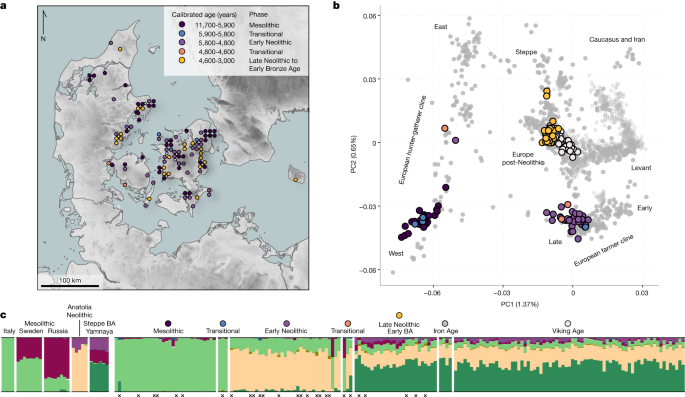
Major migration events in Holocene Eurasia have been characterized genetically at broad regional scales1,2,3,4. However, insights into the population dynamics in the contact zones are hampered by a lack of ancient genomic data sampled at high spatiotemporal resolution5,6,7. Here, to address this, we analysed shotgun-sequenced genomes from 100 skeletons spanning 7,300 years of the Mesolithic period, Neolithic period and Early Bronze Age in Denmark and integrated these with proxies for diet (13C and 15N content), mobility (87Sr/86Sr ratio) and vegetation cover (pollen). We observe that Danish Mesolithic individuals of the Maglemose, Kongemose and Ertebølle cultures form a distinct genetic cluster related to other Western European hunter-gatherers. Despite shifts in material culture they displayed genetic homogeneity from around 10,500 to 5,900 calibrated years before present, when Neolithic farmers with Anatolian-derived ancestry arrived. Although the Neolithic transition was delayed by more than a millennium relative to Central Europe, it was very abrupt and resulted in a population turnover with limited genetic contribution from local hunter-gatherers. The succeeding Neolithic population, associated with the Funnel Beaker culture, persisted for only about 1,000 years before immigrants with eastern Steppe-derived ancestry arrived. This second and equally rapid population replacement gave rise to the Single Grave culture with an ancestry profile more similar to present-day Danes. In our multiproxy dataset, these major demographic events are manifested as parallel shifts in genotype, phenotype, diet and land use.
中文翻译:

100 个古代基因组显示丹麦新石器时代反复出现人口更替
全新世欧亚大陆的重大迁移事件在广泛的区域尺度上具有遗传特征 1,2,3,4 。然而,由于缺乏以高时空分辨率 5,6,7 采样的古代基因组数据,对接触区种群动态的了解受到了阻碍。在这里,为了解决这个问题,我们分析了丹麦中石器时代、新石器时代和青铜时代早期 7,300 年的 100 具骨骼的鸟枪序列基因组,并将这些基因组与饮食( 13 C 和 15 N 含量)、流动性( 87 Sr/ 86 Sr 比率)和植被覆盖(花粉)的代理相结合。我们观察到,丹麦中石器时代 Maglemose、Kongemose 和 Ertebølle 文化的个体形成了一个与其他西欧狩猎采集者相关的独特遗传集群。尽管物质文化发生了变化,但他们表现出遗传同质性,从现在之前的 10,500 年到 5,900 年左右,当具有安纳托利亚血统的新石器时代农民到来时。尽管新石器时代的过渡相对于中欧推迟了一千多年,但它非常突然,并导致人口更替,而当地狩猎采集者的遗传贡献有限。与漏斗烧杯文化相关的新石器时代人口只持续了大约 1,000 年,然后具有东部草原血统的移民就到达了。这第二次也是同样迅速的人口更替产生了单坟文化,其祖先特征更类似于今天的丹麦人。在我们的多代理数据集中,这些主要人口统计事件表现为基因型、表型、饮食和土地利用的平行变化。



















































 京公网安备 11010802027423号