
当前位置:
X-MOL 学术
›
Glob. Change Biol.
›
论文详情
Our official English website, www.x-mol.net, welcomes your
feedback! (Note: you will need to create a separate account there.)
Long-term warming increased carbon sequestration capacity in a humid subtropical forest
Global Change Biology ( IF 12 ) Pub Date : 2023-12-11 , DOI: 10.1111/gcb.17072 Xujun Liu , Zhiyang Lie , Peter B. Reich , Guoyi Zhou , Junhua Yan , Wenjuan Huang , Yingping Wang , Josep Peñuelas , David T. Tissue , Mengdi Zhao , Ting Wu , Donghai Wu , Wenfang Xu , Yuelin Li , Xuli Tang , Shuyidan Zhou , Ze Meng , Shizhong Liu , Guowei Chu , Deqiang Zhang , Qianmei Zhang , Xinhua He , Juxiu Liu
Global Change Biology ( IF 12 ) Pub Date : 2023-12-11 , DOI: 10.1111/gcb.17072 Xujun Liu , Zhiyang Lie , Peter B. Reich , Guoyi Zhou , Junhua Yan , Wenjuan Huang , Yingping Wang , Josep Peñuelas , David T. Tissue , Mengdi Zhao , Ting Wu , Donghai Wu , Wenfang Xu , Yuelin Li , Xuli Tang , Shuyidan Zhou , Ze Meng , Shizhong Liu , Guowei Chu , Deqiang Zhang , Qianmei Zhang , Xinhua He , Juxiu Liu
|
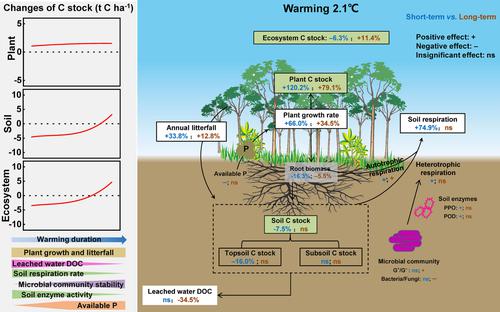
Tropical and subtropical forests play a crucial role in global carbon (C) pools, and their responses to warming can significantly impact C-climate feedback and predictions of future global warming. Despite earth system models projecting reductions in land C storage with warming, the magnitude of this response varies greatly between models, particularly in tropical and subtropical regions. Here, we conducted a field ecosystem-level warming experiment in a subtropical forest in southern China, by translocating mesocosms (ecosystem composed of soils and plants) across 600 m elevation gradients with temperature gradients of 2.1°C (moderate warming), to explore the response of ecosystem C dynamics of the subtropical forest to continuous 6-year warming. Compared with the control, the ecosystem C stock decreased by 3.8% under the first year of 2.1°C warming; but increased by 13.4% by the sixth year of 2.1°C warming. The increased ecosystem C stock by the sixth year of warming was mainly attributed to a combination of sustained increased plant C stock due to the maintenance of a high plant growth rate and unchanged soil C stock. The unchanged soil C stock was driven by compensating and offsetting thermal adaptation of soil microorganisms (unresponsive soil respiration and enzyme activity, and more stable microbial community), increased plant C input, and inhibitory C loss (decreased C leaching and inhibited temperature sensitivity of soil respiration) from soil drying. These results suggest that the humid subtropical forest C pool would not necessarily diminish consistently under future long-term warming. We highlight that differential and asynchronous responses of plant and soil C processes over relatively long-term periods should be considered when predicting the effects of climate warming on ecosystem C dynamics of subtropical forests.
更新日期:2023-12-12






















































 京公网安备 11010802027423号