
当前位置:
X-MOL 学术
›
J. Mater. Chem. A
›
论文详情
Our official English website, www.x-mol.net, welcomes your
feedback! (Note: you will need to create a separate account there.)
Achieving a dendrite-free Zn anode at high current densities via in situ polymeric interface design
Journal of Materials Chemistry A ( IF 9.5 ) Pub Date : 2023-08-07 , DOI: 10.1039/d3ta03172a Zhipei Zhong , Wenhao Ren , Suqing Wang
Journal of Materials Chemistry A ( IF 9.5 ) Pub Date : 2023-08-07 , DOI: 10.1039/d3ta03172a Zhipei Zhong , Wenhao Ren , Suqing Wang
|
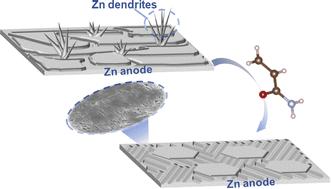
The lack of Zn anode protection is one of the hindrances to the further development of aqueous Zn ion batteries. The uneven plating morphology of Zn will lead to the formation of dendrites, largely impeding practical applications of the battery due to internal short circuits. Herein, adding acrylamide (AM) monomers establishes an in situ protective layer that effectively yields smooth plating interfaces, thus mitigating the side-reactions of corrosion and passivation. Polyacrylamide (PAM) was successfully synthesized on Zn foils, and the Zn5(OH)8Cl2·H2O-doped macromolecular skeleton subsequently provided a site for Zn2+ plating. Simulation and experimental results demonstrated that the skeleton gradually induces Zn deposition along the (002) plane, thus achieving a dendrite-less interface. Consequently, the symmetrical cell allows for significantly prolonged cycling for about 1400 h under a current density and area specific capacity of 10 mA cm−2 and 5 mA h cm−2, although remarkable stability is maintained under more severe conditions (40 mA cm−2, 40 mA h cm−2). Practical feasibilities based on introducing the AM additive are proved in Zn//NH4V4O10 full cells. This work highlights the applicability of in situ polymerization of a SEI film to realize interfacial stability by introducing an additive strategy for high-performance aqueous Zn ion batteries.
中文翻译:

通过原位聚合物界面设计在高电流密度下实现无枝晶锌阳极
锌负极保护的缺乏是水系锌离子电池进一步发展的障碍之一。锌的不均匀镀层形貌会导致枝晶的形成,由于内部短路而在很大程度上阻碍了电池的实际应用。在此,添加丙烯酰胺(AM)单体建立了原位保护层,可有效产生光滑的电镀界面,从而减轻腐蚀和钝化的副反应。在锌箔上成功合成聚丙烯酰胺(PAM),Zn 5 (OH) 8 Cl 2 ·H 2 O掺杂大分子骨架随后为Zn 2+提供了位点电镀。模拟和实验结果表明,骨架逐渐诱导Zn沿(002)面沉积,从而实现无枝晶界面。因此,对称电池允许在10 mA cm -2和5 mA h cm -2的电流密度和面积比容量下显着延长循环约1400小时,尽管在更恶劣的条件下(40 mA cm -2 )仍保持显着的稳定性。2、40mAh ·cm -2 )。基于引入AM添加剂的实际可行性在Zn//NH 4 V 4 O 10全电池中得到证明。这项工作突出了原位的适用性通过引入高性能水系锌离子电池的添加剂策略,聚合SEI膜以实现界面稳定性。
更新日期:2023-08-07
中文翻译:
通过原位聚合物界面设计在高电流密度下实现无枝晶锌阳极
锌负极保护的缺乏是水系锌离子电池进一步发展的障碍之一。锌的不均匀镀层形貌会导致枝晶的形成,由于内部短路而在很大程度上阻碍了电池的实际应用。在此,添加丙烯酰胺(AM)单体建立了原位保护层,可有效产生光滑的电镀界面,从而减轻腐蚀和钝化的副反应。在锌箔上成功合成聚丙烯酰胺(PAM),Zn 5 (OH) 8 Cl 2 ·H 2 O掺杂大分子骨架随后为Zn 2+提供了位点电镀。模拟和实验结果表明,骨架逐渐诱导Zn沿(002)面沉积,从而实现无枝晶界面。因此,对称电池允许在10 mA cm -2和5 mA h cm -2的电流密度和面积比容量下显着延长循环约1400小时,尽管在更恶劣的条件下(40 mA cm -2 )仍保持显着的稳定性。2、40mAh ·cm -2 )。基于引入AM添加剂的实际可行性在Zn//NH 4 V 4 O 10全电池中得到证明。这项工作突出了原位的适用性通过引入高性能水系锌离子电池的添加剂策略,聚合SEI膜以实现界面稳定性。




















































 京公网安备 11010802027423号