
Complex & Intelligent Systems ( IF 4.6 ) Pub Date : 2023-07-24 , DOI: 10.1007/s40747-023-01169-2 Jiajun Xu , Byeong-Geon Kim , Xiguang Feng , Kyoung-Su Park
|
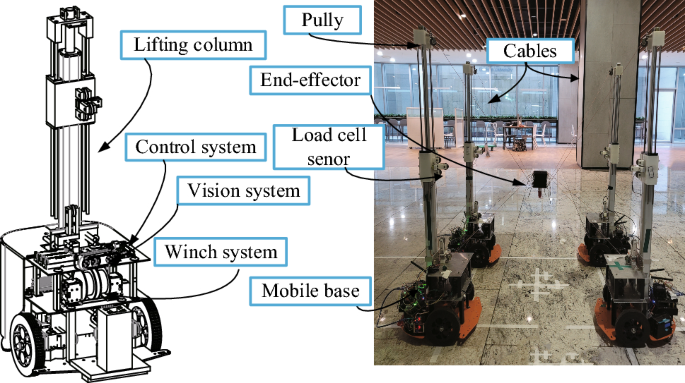
Mobile cable-driven parallel robots (MCDPRs) offer expanded motion capabilities and workspace compared to traditional cable-driven parallel robots (CDPRs) by incorporating mobile bases. However, additional mobile bases introduce more degree-of-freedom (DoF) and various constraints to make their motion planning a challenging problem. Despite several motion planning methods for MCDPRs being developed in the literature, they are only applicable to known environments, and autonomous navigation in unknown environments with obstacles remains a challenging issue. The ability to navigate autonomously is essential for MCDPRs, as it opens up possibilities for the robot to perform a broad range of tasks in real-world scenarios. To address this limitation, this study proposes an online motion planning method for MCDPRs based on the pipeline of rapidly exploring random tree (RRT). The presented approach explores unknown environments efficiently to produce high-quality collision-free trajectories for MCDPRs. To ensure the optimal execution of the planned trajectories, the study introduces two indicators specifically designed for the mobile bases and the end-effector. These indicators take into account various performance metrics, including trajectory quality and kinematic performance, enabling the determination of the final following trajectory that best aligns with the desired objectives of the robot. Moreover, to effectively handle unknown environments, a vision-based system utilizing an RGB-D camera is developed, allowing for precise MCDPR localization and obstacle detection, ultimately enhancing the autonomy and adaptability of the MCDPR. Finally, the extensive simulations conducted using dynamic simulation software (CoppeliaSim) and the on-board real-world experiments with a self-built MCDPR prototype demonstrate the practical applicability and effectiveness of the proposed method.
中文翻译:

不确定环境下自主导航的移动电缆驱动并联机器人在线运动规划
与传统电缆驱动并联机器人 (CDPR) 相比,移动电缆驱动并联机器人 (MCDPR) 通过结合移动底座提供了扩展的运动能力和工作空间。然而,额外的移动基站引入了更多的自由度(DoF)和各种约束,使其运动规划成为一个具有挑战性的问题。尽管文献中开发了多种 MCDPR 运动规划方法,但它们仅适用于已知环境,并且在有障碍物的未知环境中进行自主导航仍然是一个具有挑战性的问题。自主导航能力对于 MCDPR 至关重要,因为它为机器人在现实场景中执行各种任务提供了可能性。为了解决这个限制,本研究提出了一种基于快速探索随机树(RRT)管道的MCDPR在线运动规划方法。所提出的方法有效地探索未知环境,为 MCDPR 生成高质量的无碰撞轨迹。为了确保规划轨迹的最佳执行,研究引入了专门为移动基座和末端执行器设计的两个指标。这些指标考虑了各种性能指标,包括轨迹质量和运动学性能,从而能够确定最符合机器人预期目标的最终跟随轨迹。此外,为了有效处理未知环境,开发了一种利用 RGB-D 相机的基于视觉的系统,可以实现精确的 MCDPR 定位和障碍物检测,最终增强MCDPR的自主性和适应性。最后,利用动态仿真软件(CoppeliaSim)进行的大量仿真以及利用自建MCDPR原型进行的机载真实实验证明了该方法的实际适用性和有效性。






















































 京公网安备 11010802027423号