
Educational Technology Research and Development ( IF 4.2 ) Pub Date : 2023-06-19 , DOI: 10.1007/s11423-023-10251-y Xinping Hu , Sufiana Safiena , Yang Miang Goh , Alexander Lin
|
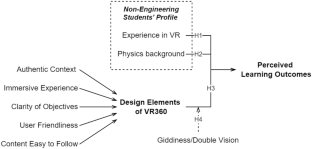
Virtual Reality (VR) provides an immersive and engaging experience that facilitates the teaching and learning of abstract concepts. This paper describes the design and implementation of the VR 360° (VR360) component of the Virtual and Augmented Reality for Structures (VARS) mobile application. This study used VARS to teach basic structural systems to 109 project and facilities management undergraduates. Based on a questionnaire survey, most students agreed that VARS VR360 helped them achieve learning outcomes. Furthermore, the study found that physics background and cybersickness did not influence the perceived effectiveness of the application, but authentic context and immersiveness are important design elements. The contributions of this paper are threefold: (1) the development of a VR360 mobile application for teaching basic structural systems concepts to non-engineering students; (2) the demonstration of how VR360 can be an effective medium for improving the teaching of structural systems to non-engineering students; (3) the identification of critical design elements and factors that influence the perceived effectiveness of VR360 educational technology.
中文翻译:

使用虚拟现实 (VR) 提高项目和设施管理学生的结构系统知识
虚拟现实 (VR) 提供身临其境、引人入胜的体验,促进抽象概念的教学和学习。本文介绍了结构虚拟和增强现实 (VARS) 移动应用程序的 VR 360° (VR360) 组件的设计和实现。本研究使用 VARS 向 109 名项目和设施管理本科生教授基本结构系统。根据问卷调查,大多数学生认为VARS VR360帮助他们取得了学习成果。此外,研究发现物理背景和晕机症不会影响应用程序的感知有效性,但真实的背景和沉浸感是重要的设计元素。本文的贡献有三个:(1) 开发VR360移动应用程序,用于向非工科学生教授基本结构系统概念;(2) 展示VR360如何成为改善非工科学生结构系统教学的有效媒介;(3)识别影响VR360教育技术感知效果的关键设计元素和因素。





































 京公网安备 11010802027423号