
Nature Communications ( IF 15.7 ) Pub Date : 2023-05-27 , DOI: 10.1038/s41467-023-38470-0 Bokang Hou , Michael Thoss , Uri Banin , Eran Rabani
|
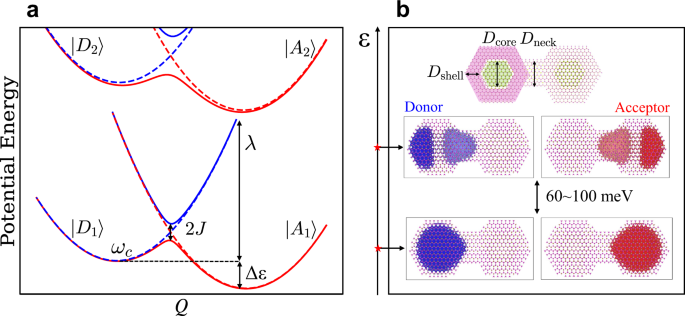
Electron transfer is a fundamental process in chemistry, biology, and physics. One of the most intriguing questions concerns the realization of the transitions between nonadiabatic and adiabatic regimes of electron transfer. Using colloidal quantum dot molecules, we computationally demonstrate how the hybridization energy (electronic coupling) can be tuned by changing the neck dimensions and/or the quantum dot sizes. This provides a handle to tune the electron transfer from the incoherent nonadiabatic regime to the coherent adiabatic regime in a single system. We develop an atomistic model to account for several states and couplings to the lattice vibrations and utilize the mean-field mixed quantum-classical method to describe the charge transfer dynamics. Here, we show that charge transfer rates increase by several orders of magnitude as the system is driven to the coherent, adiabatic limit, even at elevated temperatures, and delineate the inter-dot and torsional acoustic modes that couple most strongly to the charge transfer dynamics.
中文翻译:

胶体量子点分子中电子转移的非相干非绝热到相干绝热转变
电子转移是化学、生物学和物理学的基本过程。最有趣的问题之一涉及电子转移非绝热和绝热状态之间转变的实现。使用胶体量子点分子,我们通过计算证明了如何通过改变颈部尺寸和/或量子点尺寸来调节杂交能量(电子耦合)。这提供了在单个系统中将电子转移从不相干非绝热状态调整到相干绝热状态的手柄。我们开发了一个原子模型来解释几种状态和与晶格振动的耦合,并利用平均场混合量子经典方法来描述电荷转移动力学。在这里,我们表明,即使在高温下,当系统被驱动到相干、绝热极限时,电荷转移率也会增加几个数量级,并描绘了与电荷转移动力学耦合最强的点间和扭转声学模式。













































 京公网安备 11010802027423号