
Nature ( IF 48.5 ) Pub Date : 2023-05-24 , DOI: 10.1038/s41586-023-06086-5 Delphine Clara Zemp , Nathaly Guerrero-Ramirez , Fabian Brambach , Kevin Darras , Ingo Grass , Anton Potapov , Alexander Röll , Isabelle Arimond , Johannes Ballauff , Hermann Behling , Dirk Berkelmann , Siria Biagioni , Damayanti Buchori , Dylan Craven , Rolf Daniel , Oliver Gailing , Florian Ellsäßer , Riko Fardiansah , Nina Hennings , Bambang Irawan , Watit Khokthong , Valentyna Krashevska , Alena Krause , Johanna Kückes , Kevin Li , Hendrik Lorenz , Mark Maraun , Miryam Sarah Merk , Carina C. M. Moura , Yeni A. Mulyani , Gustavo B. Paterno , Herni Dwinta Pebrianti , Andrea Polle , Di Ajeng Prameswari , Lena Sachsenmaier , Stefan Scheu , Dominik Schneider , Fitta Setiajiati , Christina Ani Setyaningsih , Leti Sundawati , Teja Tscharntke , Meike Wollni , Dirk Hölscher , Holger Kreft
|
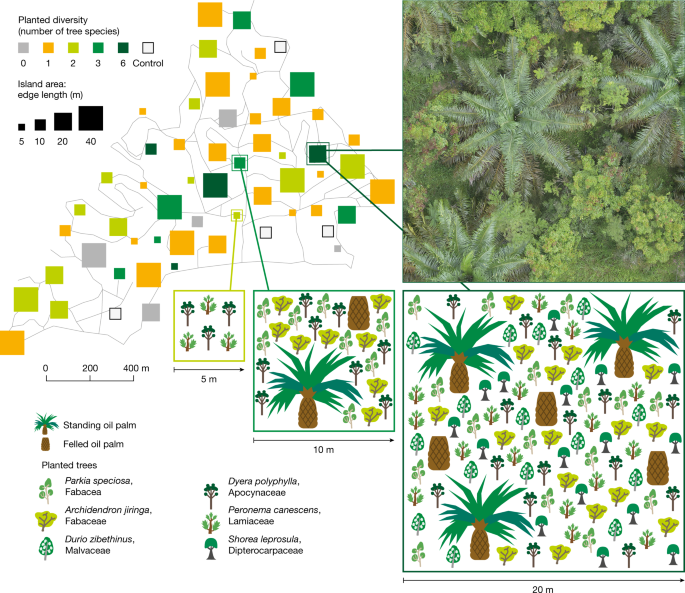
In the United Nations Decade on Ecosystem Restoration1, large knowledge gaps persist on how to increase biodiversity and ecosystem functioning in cash crop-dominated tropical landscapes2. Here, we present findings from a large-scale, 5-year ecosystem restoration experiment in an oil palm landscape enriched with 52 tree islands, encompassing assessments of ten indicators of biodiversity and 19 indicators of ecosystem functioning. Overall, indicators of biodiversity and ecosystem functioning, as well as multidiversity and ecosystem multifunctionality, were higher in tree islands compared to conventionally managed oil palm. Larger tree islands led to larger gains in multidiversity through changes in vegetation structure. Furthermore, tree enrichment did not decrease landscape-scale oil palm yield. Our results demonstrate that enriching oil palm-dominated landscapes with tree islands is a promising ecological restoration strategy, yet should not replace the protection of remaining forests.
中文翻译:

树岛增强了油棕景观的生物多样性和功能
在联合国生态系统恢复十年 1 中,在如何增加以经济作物为主的热带景观中的生物多样性和生态系统功能方面仍然存在巨大知识差距 2。在这里,我们介绍了在拥有 52 个树岛的油棕景观中进行的为期 5 年的大规模生态系统恢复实验的结果,包括对 10 个生物多样性指标和 19 个生态系统功能指标的评估。总体而言,与传统管理的油棕相比,树岛的生物多样性和生态系统功能指标以及多多样性和生态系统多功能性更高。更大的树岛通过植被结构的变化导致了多样性的更大收益。此外,树木富集并没有降低景观规模的油棕产量。我们的结果表明,用树岛丰富以油棕为主的景观是一种有前途的生态修复策略,但不应取代对剩余森林的保护。













































 京公网安备 11010802027423号