
Molecular Breeding ( IF 3 ) Pub Date : 2023-04-15 , DOI: 10.1007/s11032-023-01375-3 Xiangguang Lyu , Ruolan Mu , Bin Liu
|
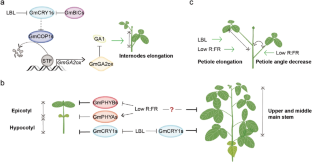
The shade avoidance syndrome (SAS) in soybean can have destructive effects on yield, as essential carbon resources reserved for yield are diverted to the petiole and stem for exaggerated elongation, resulting in lodging and susceptibility to disease. Despite numerous attempts to reduce the unfavorable impacts of SAS for the development of cultivars suitable for high-density planting or intercropping, the genetic bases and fundamental mechanisms of SAS remain largely unclear. The extensive research conducted in the model plant Arabidopsis provides a framework for understanding the SAS in soybean. Nevertheless, recent investigations suggest that the knowledge obtained from model Arabidopsis may not be applicable to all processes in soybean. Consequently, further efforts are required to identify the genetic regulators of SAS in soybean for molecular breeding of high-yield cultivars suitable for density farming. In this review, we present an overview of the recent developments in SAS studies in soybean and suggest an ideal planting architecture for shade-tolerant soybean intended for high-yield breeding.
中文翻译:

大豆的避荫综合症和耐荫性基因型
大豆的避荫综合症(SAS)会对产量产生破坏性影响,因为为产量保留的必需碳资源被转移到叶柄和茎上,导致过度伸长,导致倒伏和易患疾病。尽管人们多次尝试减少 SAS 对适合高密度种植或间作的品种开发的不利影响,但 SAS 的遗传基础和基本机制仍不清楚。在模式植物拟南芥中进行的广泛研究为理解大豆中的 SAS 提供了框架。然而,最近的研究表明,从拟南芥模型中获得的知识可能并不适用于大豆的所有过程。因此,需要进一步努力确定大豆中 SAS 的遗传调控因子,以分子育种适合密度农业的高产品种。在这篇综述中,我们概述了大豆 SAS 研究的最新进展,并提出了用于高产育种的耐荫大豆的理想种植架构。


















































 京公网安备 11010802027423号