脓毒症是指由感染引起的宿主反应障碍,导致危及生命的器官功能障碍。RNA 结合基序蛋白 3 (RBM3) 是一种重要的冷休克蛋白,在轻度低温或缺氧时会上调。在这项研究中,我们旨在调查 RBM3 是否参与脓毒症相关的急性肺损伤 (ALI)。在野生型 (WT) 和 RBM3 敲除型 (KO, RBM3 - / -) 小鼠建立体内败血症模型。在 LPS 处理前 30 分钟腹膜内注射 NLRP3 炎性体抑制剂 MCC950 (50 mg/kg)。24 小时后收集血清、肺组织和 BALF 用于进一步分析。此外,我们还收集了脓毒症患者和健康志愿者的血清来检测他们的 RBM3 表达。结果显示,LPS诱导的脓毒症小鼠肺组织和脓毒症患者血清中RBM3的表达显着升高,并与疾病严重程度呈正相关。此外,RBM3敲除(KO)小鼠存活率低,RBM3 KO小鼠比WT小鼠肺损伤、炎症、肺细胞凋亡和氧化应激更严重。LPS 处理显着增加了 RBM3 KO 小鼠肺组织中核苷酸结合和寡聚化结构域样受体家族 3 (NLRP3) 炎性体和单核细胞核因子-κB (NF-κB) 的水平。然而,这些水平在 WT 小鼠中仅略有升高。有趣的是,MCC950 改善了 LPS 诱导的 WT 和 RBM3 KO 小鼠的急性肺损伤,但抑制了 NLRP3、caspase-1 和 IL-1β 的表达。总之,RBM3 在脓毒症患者和 LPS 诱导的小鼠中过表达。RBM3 基因缺陷通过 NF-κB/NLRP3 通路加重脓毒症相关 ALI。MCC950 改善了 LPS 诱导的 WT 和 RBM3 KO 小鼠的急性肺损伤,但抑制了 NLRP3、caspase-1 和 IL-1β 的表达。总之,RBM3 在脓毒症患者和 LPS 诱导的小鼠中过表达。RBM3 基因缺陷通过 NF-κB/NLRP3 通路加重脓毒症相关 ALI。MCC950 改善了 LPS 诱导的 WT 和 RBM3 KO 小鼠的急性肺损伤,但抑制了 NLRP3、caspase-1 和 IL-1β 的表达。总之,RBM3 在脓毒症患者和 LPS 诱导的小鼠中过表达。RBM3 基因缺陷通过 NF-κB/NLRP3 通路加重脓毒症相关 ALI。
 "点击查看英文标题和摘要"
RBM3 is associated with acute lung injury in septic mice and patients via the NF-κB/NLRP3 pathway
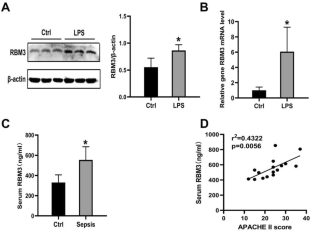
Sepsis refers to host response disorders caused by infection, leading to life-threatening organ dysfunction. RNA-binding motif protein 3 (RBM3) is an important cold-shock protein that is upregulated in response to mild hypothermia or hypoxia. In this study, we aimed to investigate whether RBM3 is involved in sepsis-associated acute lung injury (ALI). Intraperitoneal injection of LPS (10 mg/kg) was performed in wild type (WT) and RBM3 knockout (KO, RBM3−/−) mice to establish an in vivo sepsis model. An NLRP3 inflammasome inhibitor, MCC950 (50 mg/kg), was injected intraperitoneally 30 min before LPS treatment. Serum, lung tissues, and BALF were collected 24 h later for further analysis. In addition, we also collected serum from sepsis patients and healthy volunteers to detect their RBM3 expression. The results showed that the expression of RBM3 in the lung tissues of LPS-induced sepsis mice and the serum of patients with sepsis was significantly increased and positively correlated with disease severity. In addition, RBM3 knockout (KO) mice had a low survival rate, and RBM3 KO mice had more severe lung damage, inflammation, lung cell apoptosis, and oxidative stress than WT mice. LPS treatment significantly increased the levels of nucleotide binding and oligomerization domain-like receptor family 3 (NLRP3) inflammasomes and mononuclear cell nuclear factor-κB (NF-κB) in the lung tissues of RBM3 KO mice. However, these levels were only slightly elevated in WT mice. Interestingly, MCC950 improved LPS-induced acute lung injury in WT and RBM3 KO mice but inhibited the expression of NLRP3, caspase-1, and IL-1β. In conclusion, RBM3 was overexpressed in sepsis patients and LPS-induced mice. RBM3 gene deficiency aggravated sepsis-associated ALI through the NF-κB/NLRP3 pathway.




















































 京公网安备 11010802027423号