
Scientific Reports ( IF 3.9 ) Pub Date : 2022-12-29 , DOI: 10.1038/s41598-022-26644-7 Majid Aljalal , Saeed A. Aldosari , Marta Molinas , Khalil AlSharabi , Fahd A. Alturki
|
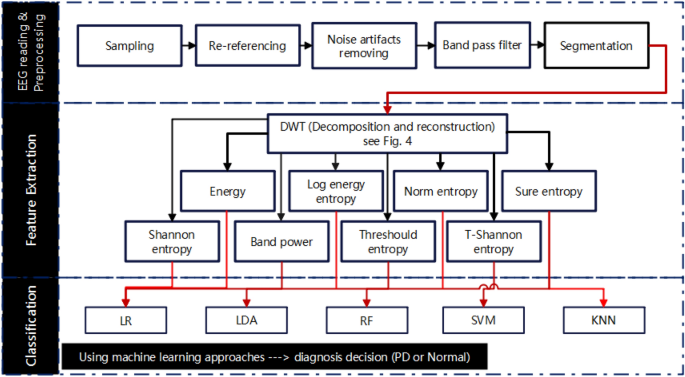
Early detection of Parkinson’s disease (PD) is very important in clinical diagnosis for preventing disease development. In this study, we present efficient discrete wavelet transform (DWT)-based methods for detecting PD from health control (HC) in two cases, namely, off-and on-medication. First, the EEG signals are preprocessed to remove major artifacts before being decomposed into several EEG sub-bands (approximate and details) using DWT. The features are then extracted from the wavelet packet-derived reconstructed signals using different entropy measures, namely, log energy entropy, Shannon entropy, threshold entropy, sure entropy, and norm entropy. Several machine learning techniques are investigated to classify the resulting PD/HC features. The effects of DWT coefficients and brain regions on classification accuracy are being investigated as well. Two public datasets are used to verify the proposed methods: the SanDiego dataset (31 subjects, 93 min) and the UNM dataset (54 subjects, 54 min). The results are promising and show that four entropy measures: log energy entropy, threshold entropy, sure entropy, and modified-Shannon entropy (TShEn) lead to high classification accuracy, indicating they are good biomarkers for PD detection. With the SanDiego dataset, the classification results of off-medication PD versus HC are 99.89, 99.87, and 99.91 for accuracy, sensitivity, and specificity, respectively, using the combination of DWT + TShEn and KNN classifier. Using the same combination, the results of on-medication PD versus HC are 94.21, 93.33, and 95%. With the UNM dataset, the obtained classification accuracy is around 99.5% in both cases of off-and on-medication PD using DWT + TShEn + SVM and DWT + ThEn + KNN, respectively. The results also demonstrate the importance of all DWT coefficients and that selecting a suitable small number of EEG channels from several brain regions could improve the classification accuracy.
中文翻译:

使用离散小波变换、不同的熵测量和机器学习技术从 EEG 信号中检测帕金森病
帕金森病 (PD) 的早期检测在预防疾病发展的临床诊断中非常重要。在这项研究中,我们提出了基于有效离散小波变换 (DWT) 的方法,用于在两种情况下从健康控制 (HC) 中检测 PD,即停药和用药。首先,对 EEG 信号进行预处理以去除主要伪影,然后使用 DWT 将其分解为多个 EEG 子带(近似和细节)。然后使用不同的熵度量从小波包派生的重构信号中提取特征,即对数能量熵、香农熵、阈值熵、确定熵和范数熵。研究了几种机器学习技术来对生成的 PD/HC 特征进行分类。DWT 系数和大脑区域对分类准确性的影响也在研究中。两个公共数据集用于验证所提出的方法:SanDiego 数据集(31 名受试者,93 分钟)和 UNM 数据集(54 名受试者,54 分钟)。结果很有希望,表明四种熵度量:对数能量熵、阈值熵、确定熵和修正香农熵 (TShEn) 具有较高的分类准确性,表明它们是 PD 检测的良好生物标志物。使用 SanDiego 数据集,使用 DWT + TShEn 和 KNN 分类器的组合,停药 PD 与 HC 的分类结果在准确性、灵敏度和特异性方面分别为 99.89、99.87 和 99.91。使用相同的组合,药物治疗 PD 与 HC 的结果分别为 94.21、93.33 和 95%。使用 UNM 数据集,在分别使用 DWT + TShEn + SVM 和 DWT + ThEn + KNN 的停药和停药 PD 情况下,获得的分类准确率约为 99.5%。结果还证明了所有 DWT 系数的重要性,并且从几个大脑区域选择合适的少量 EEG 通道可以提高分类精度。



















































 京公网安备 11010802027423号