
Nature Electronics ( IF 40.9 ) Pub Date : 2022-12-08 , DOI: 10.1038/s41928-022-00876-x Xiaoci Liang , Yiyang Luo , Yanli Pei , Mengye Wang , Chuan Liu
|
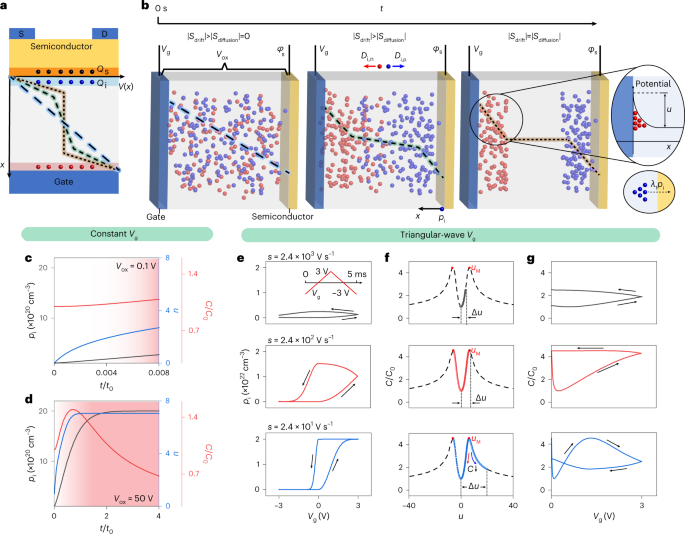
Electrolyte-gated transistors can function as switching elements, artificial synapses and memristive systems, and could be used to create compact and powerful neuromorphic computing networks. However, insight into the underlying physics of such devices, including complex ion dynamics and the resulting capacitances, remains limited. Here we report a concise model for the transient ion-dynamic capacitance in electrolyte-gated transistors. The theory predicts that plasticity, high apparent mobility, sharp subthreshold swing and memristive conductance can be achieved—on demand—in a single transistor by appropriately programming the interfacial ion concentrations or matching the scan speed with ion motions. We then fabricate such multimode transistors using common solid-state electrolyte films and experimentally confirm the different capabilities. We also show in software that the multimode devices could be used to create neural networks that can be switched between conventional artificial neural networks, recurrent neural networks and spiking neural networks.
中文翻译:

基于离子动态电容的多模晶体管和神经网络
电解质门控晶体管可用作开关元件、人工突触和忆阻系统,并可用于创建紧凑而强大的神经形态计算网络。然而,对此类设备的基础物理学(包括复杂的离子动力学和由此产生的电容)的了解仍然有限。在这里,我们报告了电解质门控晶体管中瞬态离子动态电容的简明模型。该理论预测,通过适当编程界面离子浓度或将扫描速度与离子运动相匹配,可以在单个晶体管中按需实现可塑性、高表观迁移率、急剧的亚阈值摆动和忆阻电导。然后,我们使用常见的固态电解质膜制造这种多模晶体管,并通过实验确认不同的功能。

















































 京公网安备 11010802027423号