
Nature ( IF 48.5 ) Pub Date : 2022-11-02 , DOI: 10.1038/s41586-022-05245-4 Steven A. King , Lukas J. Spieß , Peter Micke , Alexander Wilzewski , Tobias Leopold , Erik Benkler , Richard Lange , Nils Huntemann , Andrey Surzhykov , Vladimir A. Yerokhin , José R. Crespo López-Urrutia , Piet O. Schmidt
|
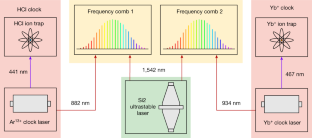
Optical atomic clocks are the most accurate measurement devices ever constructed and have found many applications in fundamental science and technology1,2,3. The use of highly charged ions (HCI) as a new class of references for highest-accuracy clocks and precision tests of fundamental physics4,5,6,7,8,9,10,11 has long been motivated by their extreme atomic properties and reduced sensitivity to perturbations from external electric and magnetic fields compared with singly charged ions or neutral atoms. Here we present the realization of this new class of clocks, based on an optical magnetic-dipole transition in Ar13+. Its comprehensively evaluated systematic frequency uncertainty of 2.2 × 10⁻¹⁷ is comparable with that of many optical clocks in operation. From clock comparisons, we improve by eight and nine orders of magnitude on the uncertainties for the absolute transition frequency12 and isotope shift (40Ar versus 36Ar) (ref. 13), respectively. These measurements allow us to investigate the largely unexplored quantum electrodynamic (QED) nuclear recoil, presented as part of improved calculations of the isotope shift, which reduce the uncertainty of previous theory14 by a factor of three. This work establishes forbidden optical transitions in HCI as references for cutting-edge optical clocks and future high-sensitivity searches for physics beyond the standard model.
中文翻译:

基于高电荷离子的光学原子钟
光学原子钟是有史以来最精确的测量设备,在基础科学和技术1,2,3中有许多应用。使用高电荷离子 (HCI) 作为最高精度时钟和基础物理学精密测试4,5,6,7,8,9,10,11的新型参考,长期以来一直受到其极端原子特性的推动与单电荷离子或中性原子相比,对外部电场和磁场扰动的敏感性降低。在这里,我们基于 Ar 13+中的光学磁偶极子跃迁展示了这种新型时钟的实现。其综合评估的系统频率不确定度为 2.2 × 10 −17可与许多运行中的光学时钟相媲美。通过时钟比较,我们将绝对跃迁频率12和同位素位移(40 Ar 与36 Ar)(参考文献 13 )的不确定性分别提高了八个和九个数量级。这些测量使我们能够研究很大程度上未被探索的量子电动力学 (QED) 核反冲,作为改进的同位素位移计算的一部分提出,它将先前理论14的不确定性降低了三倍。这项工作在 HCI 中建立了禁止的光学跃迁,作为尖端光学时钟和未来超越标准模型的物理高灵敏度搜索的参考。
















































 京公网安备 11010802027423号