
当前位置:
X-MOL 学术
›
J. Am. Chem. Soc.
›
论文详情
Our official English website, www.x-mol.net, welcomes your
feedback! (Note: you will need to create a separate account there.)
Time-Evolving Chirality Loss in Molecular Photodissociation Monitored by X-ray Circular Dichroism Spectroscopy
Journal of the American Chemical Society ( IF 15.6 ) Pub Date : 2022-10-27 , DOI: 10.1021/jacs.2c08458 Yeonsig Nam , Daeheum Cho , Bing Gu , Jérémy R. Rouxel , Daniel Keefer , Niranjan Govind , Shaul Mukamel
Journal of the American Chemical Society ( IF 15.6 ) Pub Date : 2022-10-27 , DOI: 10.1021/jacs.2c08458 Yeonsig Nam , Daeheum Cho , Bing Gu , Jérémy R. Rouxel , Daniel Keefer , Niranjan Govind , Shaul Mukamel
|
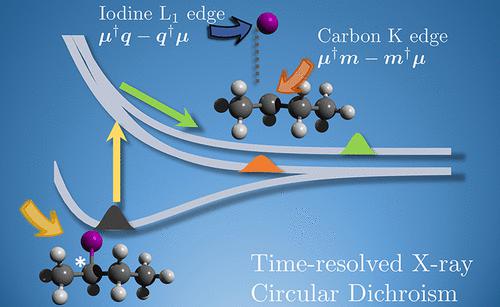
The ultrafast photoinduced chirality loss of 2-iodobutane is studied theoretically by time- and frequency-resolved X-ray circular dichroism (TRXCD) spectroscopy. Following an optical excitation, the iodine atom dissociates from the chiral center, which we capture by quantum non-adiabatic molecular dynamics simulations. At variable time delays after the pump, the resonant X-ray pulse selectively probes the iodine and carbon atom involved in the chiral dissociation through a selected core-to-valence transition. The TRXCD signal at the iodine L1 edge accurately captures the timing of C–I photodissociation and thereby chirality loss, c.a 70 fs. The strong electric dipole–electric quadrupole (ED–EQ) response makes this signal particularly sensitive to vibronic coherence at the high X-ray regime. At the carbon K-edges, the signals monitor the molecular chirality of the 2-butyl radical photoproduct and the spin state of the iodine atom. The ED–EQ response is masked under the strong electric dipole-magnetic dipole response, making this signal intuitive for the electronic population. The evolution of the core electronic states and its chiral sensitivity is discussed. Overall, the element-specific TRXCD signal provides a detailed picture of molecular dynamics and offers a unique sensitive window into the time-dependent chirality of molecules.
中文翻译:

X 射线圆二色谱监测分子光解离随时间演化的手性损失
通过时间和频率分辨的 X 射线圆二色性 (TRXCD) 光谱从理论上研究了 2-碘丁烷的超快光致手性损失。在光激发之后,碘原子从手性中心解离,我们通过量子非绝热分子动力学模拟捕获了手性中心。在泵之后的可变时间延迟下,共振 X 射线脉冲通过选定的核到价跃迁选择性地探测参与手性解离的碘和碳原子。碘 L 1处的 TRXCD 信号edge 准确地捕获了 C-I 光解离的时间,从而捕获了手性损失,大约 70 fs。强电偶极-电四极 (ED-EQ) 响应使该信号对高 X 射线范围内的电子振动相干性特别敏感。在碳 K 边缘,信号监测 2-丁基自由基光产物的分子手性和碘原子的自旋状态。ED–EQ 响应被强电偶极子-磁偶极子响应所掩盖,使该信号对于电子群体来说是直观的。讨论了核心电子态的演变及其手性敏感性。总的来说,特定元素的 TRXCD 信号提供了分子动力学的详细图片,并提供了一个独特的敏感窗口来了解分子的时间依赖性手性。
更新日期:2022-10-27
中文翻译:
X 射线圆二色谱监测分子光解离随时间演化的手性损失
通过时间和频率分辨的 X 射线圆二色性 (TRXCD) 光谱从理论上研究了 2-碘丁烷的超快光致手性损失。在光激发之后,碘原子从手性中心解离,我们通过量子非绝热分子动力学模拟捕获了手性中心。在泵之后的可变时间延迟下,共振 X 射线脉冲通过选定的核到价跃迁选择性地探测参与手性解离的碘和碳原子。碘 L 1处的 TRXCD 信号edge 准确地捕获了 C-I 光解离的时间,从而捕获了手性损失,大约 70 fs。强电偶极-电四极 (ED-EQ) 响应使该信号对高 X 射线范围内的电子振动相干性特别敏感。在碳 K 边缘,信号监测 2-丁基自由基光产物的分子手性和碘原子的自旋状态。ED–EQ 响应被强电偶极子-磁偶极子响应所掩盖,使该信号对于电子群体来说是直观的。讨论了核心电子态的演变及其手性敏感性。总的来说,特定元素的 TRXCD 信号提供了分子动力学的详细图片,并提供了一个独特的敏感窗口来了解分子的时间依赖性手性。





















































 京公网安备 11010802027423号