
Clinical Rheumatology ( IF 2.8 ) Pub Date : 2022-04-11 , DOI: 10.1007/s10067-022-06109-y Linyu Geng , Wenqiang Qu , Sen Wang , Jiaqi Chen , Yang Xu , Wei Kong , Xue Xu , Xuebing Feng , Cheng Zhao , Jun Liang , Huayong Zhang , Lingyun Sun
|
Objectives
To analyze and evaluate the effectiveness of the detection of single autoantibody and combined autoantibodies in patients with rheumatoid arthritis (RA) and related autoimmune diseases and establish a machine learning model to predict the disease of RA.
Methods
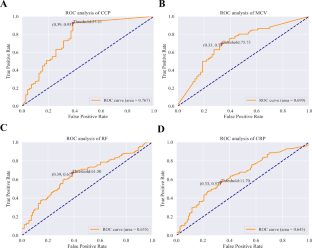
A total of 309 patients with joint pain as the first symptom were retrieved from the database. The effectiveness of single and combined antibodies tests was analyzed and evaluated in patients with RA, a cost-sensitive neural network (CSNN) model was used to integrate multiple autoantibodies and patient symptoms to predict the diagnosis of RA, and the ROC curve was used to analyze the diagnosis performance and calculate the optimal cutoff value.
Results
There are differences in the seropositive rate of autoimmune diseases, the sensitivity and specificity of single or multiple autoantibody tests were insufficient, and anti-CCP performed best in RA diagnosis and had high diagnostic value. The cost-sensitive neural network prediction model had a sensitivity of up to 0.90 and specificity of up to 0.86, which was better than a single antibody and combined multiple antibody detection.
Conclusion
In-depth analysis of autoantibodies and reliable early diagnosis based on the neural network could guide specialized physicians to develop different treatment plans to prevent deterioration and enable early treatment with antirheumatic drugs for remission.
|
Key Points • There are differences in the seropositive rate of autoimmune diseases. • This is the first study to use a cost-sensitive neural network model to diagnose RA disease in patients. • The diagnosis effect of the cost-sensitive neural network model is better than a single antibody and combined multiple antibody detection. |
中文翻译:

基于自身抗体和代价敏感神经网络的类风湿关节炎患者诊断结果预测
目标
分析评价类风湿关节炎(RA)及相关自身免疫性疾病患者单一自身抗体和联合自身抗体检测的有效性,建立预测RA疾病的机器学习模型。
方法
从数据库中检索到以关节痛为首发症状的患者 309 例。分析评估单抗体和联合抗体检测在RA患者中的有效性,采用成本敏感神经网络(CSNN)模型整合多种自身抗体和患者症状预测RA的诊断,并采用ROC曲线预测RA的诊断。分析诊断性能并计算最佳截止值。
结果
自身免疫性疾病血清阳性率存在差异,单次或多次自身抗体检测的敏感性和特异性不足,抗CCP在RA诊断中表现最佳,具有较高的诊断价值。成本敏感的神经网络预测模型灵敏度高达0.90,特异性高达0.86,优于单抗体和多抗体联合检测。
结论
基于神经网络的自身抗体的深入分析和可靠的早期诊断,可以指导专科医师制定不同的治疗方案,防止病情恶化,并能够早期使用抗风湿药物进行治疗以达到缓解。
|
要点 •自身免疫性疾病的血清阳性率存在差异。 •这是第一项使用成本敏感型神经网络模型来诊断患者 RA 疾病的研究。 •成本敏感神经网络模型的诊断效果优于单抗体和联合多抗体检测。 |



















































 京公网安备 11010802027423号