
当前位置:
X-MOL 学术
›
Chemosphere
›
论文详情
Our official English website, www.x-mol.net, welcomes your
feedback! (Note: you will need to create a separate account there.)
The influence of environmental factor on the coagulation enhanced ultrafiltration of algae-laden water: Role of two anionic surfactants to the separation performance
Chemosphere ( IF 8.1 ) Pub Date : 2021-10-29 , DOI: 10.1016/j.chemosphere.2021.132745 Tingting Zhu , Fangshu Qu , Bin Liu , Heng Liang
Chemosphere ( IF 8.1 ) Pub Date : 2021-10-29 , DOI: 10.1016/j.chemosphere.2021.132745 Tingting Zhu , Fangshu Qu , Bin Liu , Heng Liang
|
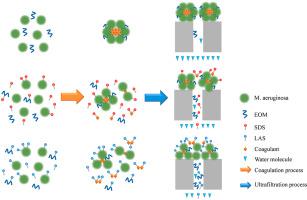
With the acceleration of urbanization and the improvement of people's living standards, more chemicals that humans rely on are entering the city and surrounding water bodies. Anionic surfactants are one of the essential products for human beings. It is also one of the inducements that cause the eutrophication. The algae-laden water caused by eutrophication is a headache in the traditional water treatment process. To solve the problem, ultrafitration combined process was widely investigated to treat the algae-laden water. The presence of stimuli, low concentration anionic surfactant, probably interfere the performance of ultrafiltration process during algae-laden water treatment. In this study, the influence of two typical anionic surfactants, sodium dodecyl sulfate (SDS) and sodium dodecyl benzene sulfonate (LAS), on the performance of coagulation-enhanced ultrafiltration was investigated. The aluminum sulfate hydrate and iron sulfate hydrate were respectively employed as coagulant. Based on the residual turbidity and zeta potential, 4 mg/L Al and 8 mg/L Fe were determined as the optimal coagulant dosage. The floc morphology confirmed that Al-algae flocs with lower fractal dimension (Df ) were looser and more porous compared to Fe-algae flocs. More coagulant was depleted by LAS due to the better hydrophobicity of LAS. During the filtration process, LAS caused a larger flux reduction compared with SDS regardless of the coagulant that was used. More organic compounds penetrate into membrane pores and block the pores with the presence of LAS since algal cell aggregation was weakened. Finally, the rejection of organic compounds by the coagulation-enhanced ultrafiltration process was studied, and the co-existing surfactants can cause effluent deterioration. Therefore, the presence of surfactants has a negative effect to the ultrafiltration treatment of algae-laden water.
中文翻译:

环境因素对含藻水混凝增强超滤的影响:两种阴离子表面活性剂对分离性能的作用
随着城市化进程的加快和人们生活水平的提高,更多人类赖以生存的化学物质正在进入城市和周边水体。阴离子表面活性剂是人类必不可少的产品之一。它也是导致富营养化的诱因之一。富营养化导致的含藻水是传统水处理过程中令人头疼的问题。为了解决这个问题,广泛研究了超磷合组合工艺来处理含藻水。低浓度阴离子表面活性剂的刺激物的存在可能会干扰含藻水处理过程中超滤过程的性能。本研究研究了两种典型的阴离子表面活性剂十二烷基硫酸钠(SDS)和十二烷基苯磺酸钠(LAS)对混凝增强超滤性能的影响。分别采用硫酸铝水合物和硫酸铁水合物作为混凝剂。根据残余浊度和 zeta 电位,确定 4 mg/L Al 和 8 mg/L Fe 为最佳混凝剂用量。絮体形态证实,与铁藻絮体相比,分形维数(Df)较低的铝藻絮体更松散、多孔性更强。由于 LAS 具有较好的疏水性,LAS 消耗了更多的凝血剂。在过滤过程中,无论使用何种混凝剂,与 SDS 相比,LAS 都会引起更大的通量减少。由于藻类细胞聚集减弱,更多的有机化合物渗透到膜孔中并堵塞孔隙,并随着 LAS 的存在而堵塞孔隙。最后,研究了混凝增强超滤工艺对有机化合物的排斥作用,以及共存的表面活性剂可引起出水变质。 因此,表面活性剂的存在对含藻水的超滤处理有负面影响。
更新日期:2021-10-29
中文翻译:
环境因素对含藻水混凝增强超滤的影响:两种阴离子表面活性剂对分离性能的作用
随着城市化进程的加快和人们生活水平的提高,更多人类赖以生存的化学物质正在进入城市和周边水体。阴离子表面活性剂是人类必不可少的产品之一。它也是导致富营养化的诱因之一。富营养化导致的含藻水是传统水处理过程中令人头疼的问题。为了解决这个问题,广泛研究了超磷合组合工艺来处理含藻水。低浓度阴离子表面活性剂的刺激物的存在可能会干扰含藻水处理过程中超滤过程的性能。本研究研究了两种典型的阴离子表面活性剂十二烷基硫酸钠(SDS)和十二烷基苯磺酸钠(LAS)对混凝增强超滤性能的影响。分别采用硫酸铝水合物和硫酸铁水合物作为混凝剂。根据残余浊度和 zeta 电位,确定 4 mg/L Al 和 8 mg/L Fe 为最佳混凝剂用量。絮体形态证实,与铁藻絮体相比,分形维数(Df)较低的铝藻絮体更松散、多孔性更强。由于 LAS 具有较好的疏水性,LAS 消耗了更多的凝血剂。在过滤过程中,无论使用何种混凝剂,与 SDS 相比,LAS 都会引起更大的通量减少。由于藻类细胞聚集减弱,更多的有机化合物渗透到膜孔中并堵塞孔隙,并随着 LAS 的存在而堵塞孔隙。最后,研究了混凝增强超滤工艺对有机化合物的排斥作用,以及共存的表面活性剂可引起出水变质。 因此,表面活性剂的存在对含藻水的超滤处理有负面影响。












 京公网安备 11010802027423号