
Science of the Total Environment ( IF 8 ) Pub Date : 2021-01-06 , DOI: 10.1016/j.scitotenv.2020.144450 Huaicheng Zhang , Shudi Zhao , Aimin Li , Kaiqin Bian , Shanqi Shen , Meng Tao , Peng Shi
|
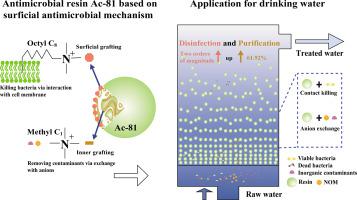
The demand for powerful and multifunctional water-treatment materials and reagents is increasing, because we are facing worse raw water quality, various tolerant bacteria, and risky disinfection by-products (DBPs) in drinking water. Quaternary ammonium resins (QARs) are promising candidates for water disinfection and purification, but their limited bactericidal capacities are difficult to improve because of the lack of guidelines for enhancing antibacterial efficiency. Therefore, we first systematically studied the structure-dependent antimicrobial mechanism of QARs and found that the best resin skeleton is acrylic-type, the optimal bactericidal alkyl is hexyl or octyl, the most applicable sizes are 80–100 meshes, the best counter anion is iodide ion, and the optimum quaternization reagent is iodoalkane. Moreover, the antibacterial capacity was demonstrated to depend on surficial N+ groups, correlating with surficial N+ charge density (R2 of 0.98) but not with exchange capacity (R2 of 0.26), physical adsorption of resin skeleton, or electrostatic adsorption of N+ groups. Based on these principles, we synthesized a new resin, Ac-81, with a surficial antibacterial design, which simultaneously exhibited better antimicrobial efficiency (two orders of magnitude) as well as higher contaminant removal potential (61.92%) compared to the traditional Ac-8C antibacterial resin. Furthermore, the new resin showed remarkable broad-spectrum antibacterial effects against Gram-negative E. coli and P. aeruginosa and Gram-positive B. subtilis and S. aureus in simulated water and actual water. Simultaneously, water quality was significantly improved, with HCO3−, SO42−, TN, TP, and TOC reduced by 79–90%, >99%, 66–85%, >99%, and 22–26%, respectively. Ac-81 is characterized by facile reusability, high treatment capacity of 1500 bed volume, and good adaptability for treating actual water, providing a promising alternative for drinking-water disinfection and purification.
中文翻译:

季铵盐树脂的结构依赖性抗菌机理及高效抗菌树脂的新型合成
对功能强大的多功能水处理材料和试剂的需求正在增长,因为我们面临着更糟糕的原水质量,各种耐受细菌以及饮用水中危险的消毒副产物(DBP)。季铵树脂(QAR)是用于水消毒和净化的有前途的候选物,但由于缺乏提高抗菌效率的指导方针,因此难以提高其有限的杀菌能力。因此,我们首先系统地研究了QAR的结构依赖性抗菌机理,发现最佳的树脂骨架为丙烯酸型,最佳的杀菌烷基为己基或辛基,最适用的大小为80-100目,最佳的抗衡阴离子为碘化物离子,最佳的季铵化试剂是碘烷。此外,+基团与表面N +电荷密度(R 2为0.98)相关,但与交换容量(R 2为0.26),树脂骨架的物理吸附或N +基团的静电吸附无关。根据这些原理,我们合成了一种具有表面抗菌设计的新型树脂Ac-81,与传统的Ac-81相比,该树脂同时具有更好的抗菌效率(两个数量级)和更高的去污潜力(61.92%)。 8C抗菌树脂。此外,这种新树脂对革兰氏阴性大肠杆菌,铜绿假单胞菌和革兰氏阳性枯草芽孢杆菌显示出显着的广谱抗菌作用。和金黄色葡萄球菌在模拟水和实际水中。同时,水质显著改善,HCO 3 -,SO 4 2-,TN,TP,和TOC降低79-90%,> 99%,66-85%,> 99%,22-26%,分别。Ac-81的特点是易于重复使用,1500床体积的高处理能力以及对实际水的处理的良好适应性,为饮用水消毒和净化提供了有希望的替代方法。



















 京公网安备 11010802027423号