Recently, the team led by Cai Jinming, Lu Jianchen, and Gao Lei from our university collaborated with Researcher Du Shixuan from the Institute of Physics, Chinese Academy of Sciences, Professor Tan Yuanzhi, and Associate Professor Zhao Xinjing from Xiamen University. They achieved significant progress in the atomic - scale precise construction and physical property characterization of low - dimensional quantum material heterostructures. The related work was published in Nature Communications under the title "Synthesis of mixed - dimensional 1D - graphene nanoribbon/2D - CuSe heterostructures with controllable band alignments".
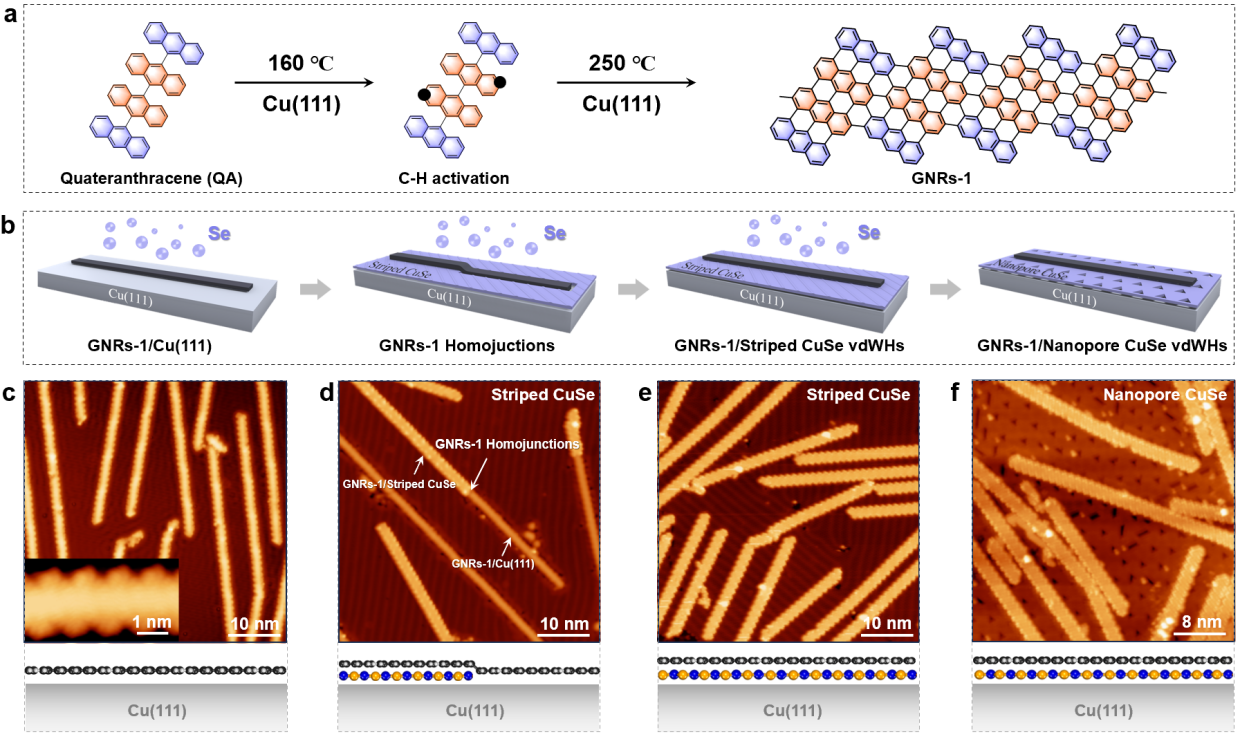
One - dimensional/two - dimensional (1D/2D) heterostructures have attracted extensive research interest due to their high - efficiency optoelectronic and catalytic properties. The key to achieving the large - scale application of 1D/2D heterostructures lies in precisely regulating their band alignments, which remains a challenge in experiments. To address this issue, the team proposed a hierarchical growth strategy. First, graphene nanoribbons (GNRs) were synthesized on the surface of Cu(111). Then, selenium atoms were deposited on the pre - prepared GNRs samples. After thermal annealing, the selenium atoms reacted with the copper atoms in the substrate to form a copper selenide (CuSe) monolayer. By controlling the deposition amount of selenium atoms, GNRs homojunctions and 1D - GNR/2D - CuSe heterostructures were precisely obtained at the atomic scale. The entire growth process was observed in real - space through scanning tunneling microscopy, non - contact atomic force microscopy characterization, and density functional theory calculations. The electrical properties of GNRs homojunctions and 1D - GNR/2D - CuSe heterostructures were measured using scanning tunneling spectroscopy. The measurement results show that the GNRs - 1 homojunction exhibits p - n junction characteristics in band alignment, while the 1D - GNR/2D - CuSe heterojunction has adjustable band alignments (type I and type II). This work provides a promising method for the precise synthesis of 1D/2D heterostructures with different band alignments, contributing to the development of high - performance nanodevices.