Ferritin‐Nanocaged Aggregation‐Induced Emission Drug Vitexin Inhibits Ferroptosis to Treat Asthenozoospermia
Advanced Functional Materials ( IF 19 ) Pub Date : 2025-10-29 , DOI: 10.1002/adfm.202522020
Xinghua Yu , Yujun Zhang , Lingan Zeng , Haiyan Chen , Xuemei Dong , Tianfu Zhang , Ben Zhong Tang , Fei Sun
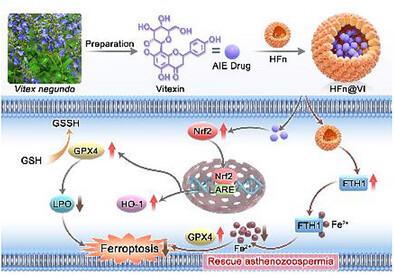 |
Asthenozoospermia, a major cause of male infertility characterized by impaired sperm motility, is critically driven by oxidative stress and dysregulated iron metabolism, which directly induce ferroptosis in sperm cells. To address this, a novel nanotheranostic platform utilizing ferritin nanocages to encapsulate vitexin, a natural flavonoid with potent antioxidant properties and unique aggregation‐induced emission (AIE) characteristics, is introduced. This ferritin nanocage‐loaded vitexin (HFn@VI) system combines the iron‐chelating capability of ferritin with vitexin's ability to mitigate oxidative stress, enabling precise dual‐targeting of the ferroptotic pathways in spermatogenic cells. In the asthenozoospermia model mice, HFn@VI significantly improves sperm count and kinematic parameters (motility, velocity) without observable systemic toxicity, demonstrating superior therapeutic efficacy. Mechanistic studies reveal that the ferritin component elevates ferritin heavy chain 1(FTH1) levels, sequestering free iron ions and reducing cellular iron overload. Concurrently, vitexin activates the nuclear factor erythroid 2‐related factor 2 (Nrf2)/heme oxygenase‐1 (HO‐1) pathway, enhancing glutathione peroxidase 4 (GPX4) expression to inhibit lipid peroxidation and ferroptosis. This study pioneers the application of vitexin, a natural product exhibiting AIE characteristics, as a therapeutic agent in reproductive medicine and underscores the potential of dual‐target nanomedicines for precise ferroptosis intervention, establishing a new paradigm for treating male infertility through advances in material science.
中文翻译:

铁蛋白纳米笼聚集诱导发射药物荆条抑制铁死亡治疗弱精子症
弱精子症是男性不育症的主要原因,其特征是精子活力受损,其关键驱动因素是氧化应激和铁代谢失调,直接诱导精子细胞铁死亡。为了解决这个问题,引入了一种新型纳麦素分析平台,利用铁蛋白纳米笼封装牡荆素,牡荆素是一种具有强大抗氧化特性和独特聚集诱导发射 (AIE) 特性的天然类黄酮。这种载有铁蛋白纳米笼的牡荆素 (HFn@VI) 系统结合了铁蛋白的铁螯合能力和牡荆素减轻氧化应激的能力,能够精确地双靶向生精细胞中的铁通路。在弱精子动物症模型小鼠中,HFn@VI 显着改善精子数量和运动学参数(运动性,速度),而没有观察到的全身毒性,显示出卓越的治疗效果。机理研究表明,铁蛋白成分可提高铁蛋白重链 1 (FTH1) 水平,螯合游离铁离子并减少细胞铁过载。同时,牡荆素激活核因子红细胞 2 相关因子 2 (Nrf2)/血红素加氧酶 1 (HO-1) 通路,增强谷胱甘肽过氧化物酶 4 (GPX4) 的表达,从而抑制脂质过氧化和铁死亡。本研究开创了具有 AIE 特性的天然产物牡荆素作为治疗剂在生殖医学中的应用,强调了双靶点纳米药物在铁死亡精准干预方面的潜力,通过材料科学的进步为治疗男性不育症建立了新的范式。
Blood-testis barrier-crossing extracellular vesicles for asthenozoospermia therapy via synergistic ATP replenishment and ferroptosis suppression
Biomaterials ( IF 12.9 ) Pub Date : 2025-10-13 , DOI: 10.1016/j.biomaterials.2025.123777
Xinghua Yu , Lingan Zeng , Haiyan Chen , Xuemei Dong , Fan Wen , Mingming Wang , Runqi Pan , Yujun Zhang , Wei Zhu , Dingyuan Yan , Dong Wang , Fei Sun
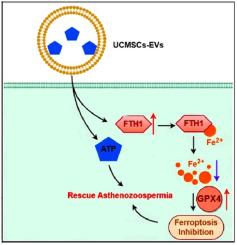 |
Asthenozoospermia, a leading cause of male infertility characterized by impaired sperm motility, poses significant therapeutic challenges due to the restrictive blood-testis barrier (BTB). To address this limitation, we engineered multifunctional extracellular vesicles (EVs) derived from umbilical cord mesenchymal stem cells, loaded with adenosine triphosphate (ATP) to synergistically restore cellular bioenergetics and suppress ferroptosis. These EVs were further functionalized with an aggregation-induced emission luminogen for near-infrared-II (NIR-II) fluorescence imaging, enabling real-time visualization of their efficient BTB penetration and targeted accumulation within testicular tissues. Upon localization in the seminiferous tubules, the released ATP directly replenishes the energy reserves of spermatogenic cells and enhances sperm motility in asthenozoospermia models. Simultaneously, the EVs upregulate glutathione peroxidase 4, mitigating ferroptosis and synergizing with ATP to restore metabolic homeostasis. In vivo studies demonstrate the dual efficacy of this platform: the EVs precisely traverse the BTB while robustly inhibiting ferroptosis without systemic toxicity, significantly improving sperm count and kinematic parameters (motility, velocity). This study presents a multifunctional nanoplatform that integrates NIR–II–guided imaging, ATP-mediated energy restoration, and pathology-specific ferroptosis inhibition, providing a promising non-invasive therapeutic strategy for asthenozoospermia.
An NIR‐II Absorbing Injectable Hydrogel for Boosted Photo‐Immunotherapy Toward Human Papillomavirus Associated Cancer
Aggregate ( IF 13.9 ) Pub Date : 2025-01-21 , DOI: 10.1002/agt2.743
Xinghua Yu 1 , Lingan Zeng 1 , Xinyue Yang 2 , Zuliang Ren 1 , Xuemei Dong 1 , Ge Meng 1 , Guogang Shan 2 , Dingyuan Yan 3 , Dong Wang 3 , Fei Sun 1
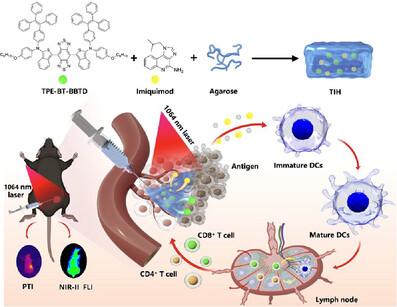 |
Human papillomavirus (HPV) is a highly prevalent venereal pathogen accounting for genital warts and various cancers like cervical, anal, and oropharyngeal cancers. Although imiquimod, a topical medication, is commonly used to treat genital warts induced by HPV, its potential as an in situ immune response regulator for HPV‐related cancers has rarely been explored. In this study, we developed an innovative synergistic therapeutic platform by integrating near‐infrared‐II (NIR‐II) absorbing aggregation‐induced emission (AIE) agent (TPE‐BT‐BBTD) and imiquimod into an injectable hydrogel named TIH. TPE‐BT‐BBTD molecule that serves as a photothermal agent, with exposure to a 1064 nm laser, effectively destroys tumor cells and releases tumor‐related antigens. During the thermogenesis process, the hydrogel melts and releases imiquimod. The released imiquimod, in conjunction with the dead tumor antigens, stimulates dendritic cell maturation, activating the immune system to ultimately eliminate residual cancer cells. This novel approach combines the immunomodulatory effects of imiquimod with a 1064 nm‐excitable photothermal agent in a hydrogel delivery system, offering a promising tactic for combating HPV‐associated cancers.
Impact of leachate from boiled-water-treated plastic products on male reproductive health: Insights from transcriptomic and metabolomic profiling
Ecotoxicology and Environmental Safety ( IF 6.2 ) Pub Date : 2025-01-15 , DOI: 10.1016/j.ecoenv.2025.117748
Xinghua Yu 1 , Rui Yao 2 , Ge Meng 1 , Lingan Zeng 1 , Leyi Zhou 1 , Yingkang Shen 1 , Amali Upekshika Wijayaraja 1 , Reshmi Hareendra Kariyapperuma 1 , Wentao Xu 1 , Yuxiang Mei 1 , Xinyan Gu 1 , Wen-Long Lei 1 , Pengfei Zhang 3 , Fei Sun 1
Given the extensive use of plastic materials in modern society, there is an escalating concern about the potential risks associated with exposure to plastic products. This study investigated the impact of plastic leachates from boiled-water-treated cups, including polypropylene (PP), high-density polyethylene (HDPE), low-density polyethylene (LDPE), polystyrene (PS), and polyethylene terephthalate (PET), on male reproductive health. Experimental mice were administered daily doses of the plastic leachates for 180 consecutive days. Histological analysis of the testes and epididymis was conducted, revealing vacuolization and absence of sperms in the seminiferous tubules of mice treated with PP, HDPE, LDPE, and PS, while PET exhibited lower reproductive toxicity. Furthermore, transcriptomic and metabolomic profiling were employed to identify key genes and metabolites related to plastic exposure. Transcriptome analysis showed significant changes in genes associated with spermatogenesis following exposure to leachates, while metabolome analysis indicated an impact on the lipid metabolism pathway. Overall, the study provides evidence that oral exposure to leachates from boiled-water-treated plastic cups could negatively affect spermatogenesis and lipid metabolism, thereby posing risks to male reproductive health. These findings offer crucial insights into the potential risks associated with plastic consumption and may advocate for the selection of relatively safe plastic cups for everyday use.
Recognition of cyclic dinucleotides and folates by human SLC19A1
Nature ( IF 50.5 ) Pub Date : 2022-10-20 , DOI: 10.1038/s41586-022-05452-z
Qixiang Zhang 1, 2 , Xuyuan Zhang 1 , Yalan Zhu 3 , Panpan Sun 1, 2 , Liwei Zhang 1 , Junxiao Ma 1 , Yong Zhang 4 , Lingan Zeng 1, 2 , Xiaohua Nie 1 , Yina Gao 1, 5 , Zhaolong Li 1, 2 , Songqing Liu 1, 5 , Jizhong Lou 2, 4 , Ang Gao 3 , Liguo Zhang 1, 2 , Pu Gao 1, 2, 5, 6
Cyclic dinucleotides (CDNs) are ubiquitous signaling molecules in all domains of life1,2. Mammalian cells produce one CDN, 2'3'-cGAMP, by cyclic GMP-AMP synthase upon detecting cytosolic DNA signals3-7. 2'3'-cGAMP, as well as bacterial and synthetic CDN analogs, can act as second messengers to activate stimulator of interferon genes (STING) and elicit broad downstream responses8-21. Extracellular CDNs must traverse the cell membrane to activate STING, a process that is critically dependent on the solute carrier SLC19A122,23. In addition, SLC19A1 represents the major transporter for folate nutrients and antifolate therapeutics24,25, thereby placing SLC19A1 as a key factor in multiple physiological and pathological processes. How SLC19A1 recognizes and transports CDNs and folate/antifolate is unknown. Here we report cryo-electron microscopy structures of human SLC19A1 (hSLC19A1) in a substrate-free state and in complexes with multiple CDNs from different sources, a predominant natural folate, and a new-generation antifolate drug. Structural and mutagenesis results demonstrate that hSLC19A1 utilizes unique yet divergent mechanisms to recognize CDN- and folate-type substrates. Two CDN molecules bind within the hSLC19A1 cavity as a compact dual-molecule unit, while folate or antifolate binds as a monomer and occupies a distinct pocket of the cavity. Moreover, the structures allow accurate mapping and potential mechanistic interpretation of loss-of-activity and disease-related mutations of hSLC19A1. Our work provides a framework for understanding the mechanism of SLC19 family transporters and serves as a foundation for the development of potential therapeutics.