Ferritin-nanocaged aggregation-induced emission nanoaggregates for NIR-II fluorescence-guided noninvasive, controllable male contraception
Materials Today Bio ( IF 8.2 ) Pub Date : 2024-02-13 , DOI: 10.1016/j.mtbio.2024.100995
Xinghua Yu , Jiaxue Shuai , Ge Meng , Shumin Zhou , Amali Upekshika Wijayaraja , Yixiang Zhao , Lei Yao , Rui Yao , Xing Yang , Tianfu Zhang , Liying Wang , Pengyu Gu , Pengfei Zhang , Fei Sun
Controllable contraception in male animals was demonstrated through the utilization of gold nanorods' photothermal effect to accomplish mild testicular hyperthermia. However, the challenges arising from testicular administration and the non-biodegradability of nanoparticles hinder further clinical implementation. Therefore, a straightforward, non-invasive, and enhanced contraception approach is required. This study explores the utilization of human heavy chain ferritin (HFn) nanocarriers loaded with aggregation-induced emission luminogens (AIEgens) for noninvasive, controllable male contraception guided by Near-Infrared-II (NIR-II) fluorescence imaging. The HFn-caged AIEgens (HFn@BBT) are delivered via intravenous injection and activated by near-infrared irradiation. Lower hyperthermia treatment induces partial damage to the testes and seminiferous tubules, reducing fertility indices by approximately 100% on the 7th day, which gradually recovers to 80% on the 60th day. Conversely, implementation of elevated hyperthermia therapy causes total destruction of both testes and seminiferous tubules, leading to a complete loss of fertility on the 60th day. Additionally, the use of AIEgens in NIR-II imaging offers improved fluorescence efficiency and penetration depth. The findings of this study hold significant promise for the advancement of safe and effective male contraceptive methods, addressing the need for noninvasive and controllable approaches to reproductive health and population control.
Impact of leachate from boiled-water-treated plastic products on male reproductive health: Insights from transcriptomic and metabolomic profiling
Ecotoxicology and Environmental Safety ( IF 6.2 ) Pub Date : 2025-01-15 , DOI: 10.1016/j.ecoenv.2025.117748
Xinghua Yu 1 , Rui Yao 2 , Ge Meng 1 , Lingan Zeng 1 , Leyi Zhou 1 , Yingkang Shen 1 , Amali Upekshika Wijayaraja 1 , Reshmi Hareendra Kariyapperuma 1 , Wentao Xu 1 , Yuxiang Mei 1 , Xinyan Gu 1 , Wen-Long Lei 1 , Pengfei Zhang 3 , Fei Sun 1
Given the extensive use of plastic materials in modern society, there is an escalating concern about the potential risks associated with exposure to plastic products. This study investigated the impact of plastic leachates from boiled-water-treated cups, including polypropylene (PP), high-density polyethylene (HDPE), low-density polyethylene (LDPE), polystyrene (PS), and polyethylene terephthalate (PET), on male reproductive health. Experimental mice were administered daily doses of the plastic leachates for 180 consecutive days. Histological analysis of the testes and epididymis was conducted, revealing vacuolization and absence of sperms in the seminiferous tubules of mice treated with PP, HDPE, LDPE, and PS, while PET exhibited lower reproductive toxicity. Furthermore, transcriptomic and metabolomic profiling were employed to identify key genes and metabolites related to plastic exposure. Transcriptome analysis showed significant changes in genes associated with spermatogenesis following exposure to leachates, while metabolome analysis indicated an impact on the lipid metabolism pathway. Overall, the study provides evidence that oral exposure to leachates from boiled-water-treated plastic cups could negatively affect spermatogenesis and lipid metabolism, thereby posing risks to male reproductive health. These findings offer crucial insights into the potential risks associated with plastic consumption and may advocate for the selection of relatively safe plastic cups for everyday use.
An NIR‐II Absorbing Injectable Hydrogel for Boosted Photo‐Immunotherapy Toward Human Papillomavirus Associated Cancer
Aggregate ( IF 13.9 ) Pub Date : 2025-01-21 , DOI: 10.1002/agt2.743
Xinghua Yu 1 , Lingan Zeng 1 , Xinyue Yang 2 , Zuliang Ren 1 , Xuemei Dong 1 , Ge Meng 1 , Guogang Shan 2 , Dingyuan Yan 3 , Dong Wang 3 , Fei Sun 1
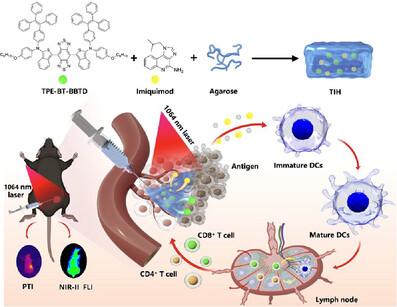 |
Human papillomavirus (HPV) is a highly prevalent venereal pathogen accounting for genital warts and various cancers like cervical, anal, and oropharyngeal cancers. Although imiquimod, a topical medication, is commonly used to treat genital warts induced by HPV, its potential as an in situ immune response regulator for HPV‐related cancers has rarely been explored. In this study, we developed an innovative synergistic therapeutic platform by integrating near‐infrared‐II (NIR‐II) absorbing aggregation‐induced emission (AIE) agent (TPE‐BT‐BBTD) and imiquimod into an injectable hydrogel named TIH. TPE‐BT‐BBTD molecule that serves as a photothermal agent, with exposure to a 1064 nm laser, effectively destroys tumor cells and releases tumor‐related antigens. During the thermogenesis process, the hydrogel melts and releases imiquimod. The released imiquimod, in conjunction with the dead tumor antigens, stimulates dendritic cell maturation, activating the immune system to ultimately eliminate residual cancer cells. This novel approach combines the immunomodulatory effects of imiquimod with a 1064 nm‐excitable photothermal agent in a hydrogel delivery system, offering a promising tactic for combating HPV‐associated cancers.